

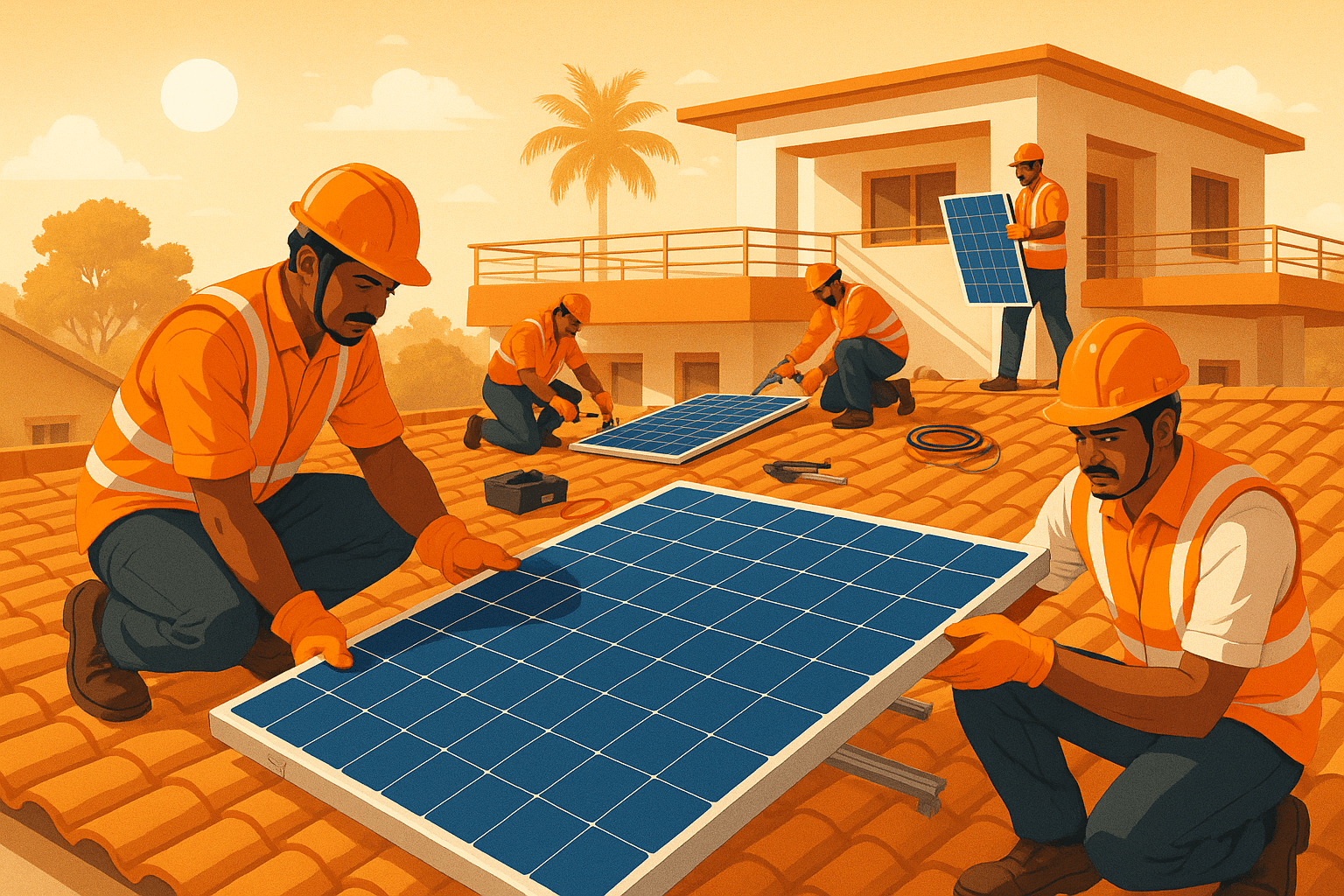
Complete Guide to Rooftop Solar Installation in India (2026): Costs, Types, ROI & Process
India is in the middle of a solar revolution. With over 2 million rooftop solar systems installed under the PM Surya Ghar scheme by December 2025, electricity bills across the country are shrinking while rooftops are turning into miniature power plants. The government has committed Rs 75,021 crore to the programme, and the numbers tell a clear story: there has never been a better time to go solar.
Whether you live in a bungalow in Dhule, a flat in Pune, or a farmhouse in Nashik, this guide walks you through everything you need to know before installing rooftop solar in 2026 -- panel types, system configurations, real costs, subsidies, ROI calculations, and the exact steps from inquiry to commissioning.
Why 2026 Is the Best Time to Go Solar in India
Three forces have converged to make rooftop solar more affordable and accessible than ever:
-
Panel prices have dropped sharply. India now manufactures over 73 GW worth of solar modules domestically. Increased competition among 100+ ALMM-listed manufacturers has pushed the cost of solar panels to Rs 35--55 per watt, roughly half of what it was five years ago.
-
Government subsidies are at their peak. The PM Surya Ghar Muft Bijli Yojana provides direct bank transfers of up to Rs 78,000 for residential rooftop systems. The scheme runs until FY 2026-27, but funds are finite and demand is surging.
-
Electricity tariffs keep rising. MSEDCL's average residential tariff in Maharashtra is now around Rs 8 per unit and climbing. A solar system locks in your energy cost at effectively zero for 25 years.
The math is simple: install now, claim the full subsidy, and start saving from month one.
Types of Solar Panels: Which One Is Right for You?
Not all solar panels are created equal. The four main types available in India each come with distinct trade-offs in efficiency, cost, and suitability.
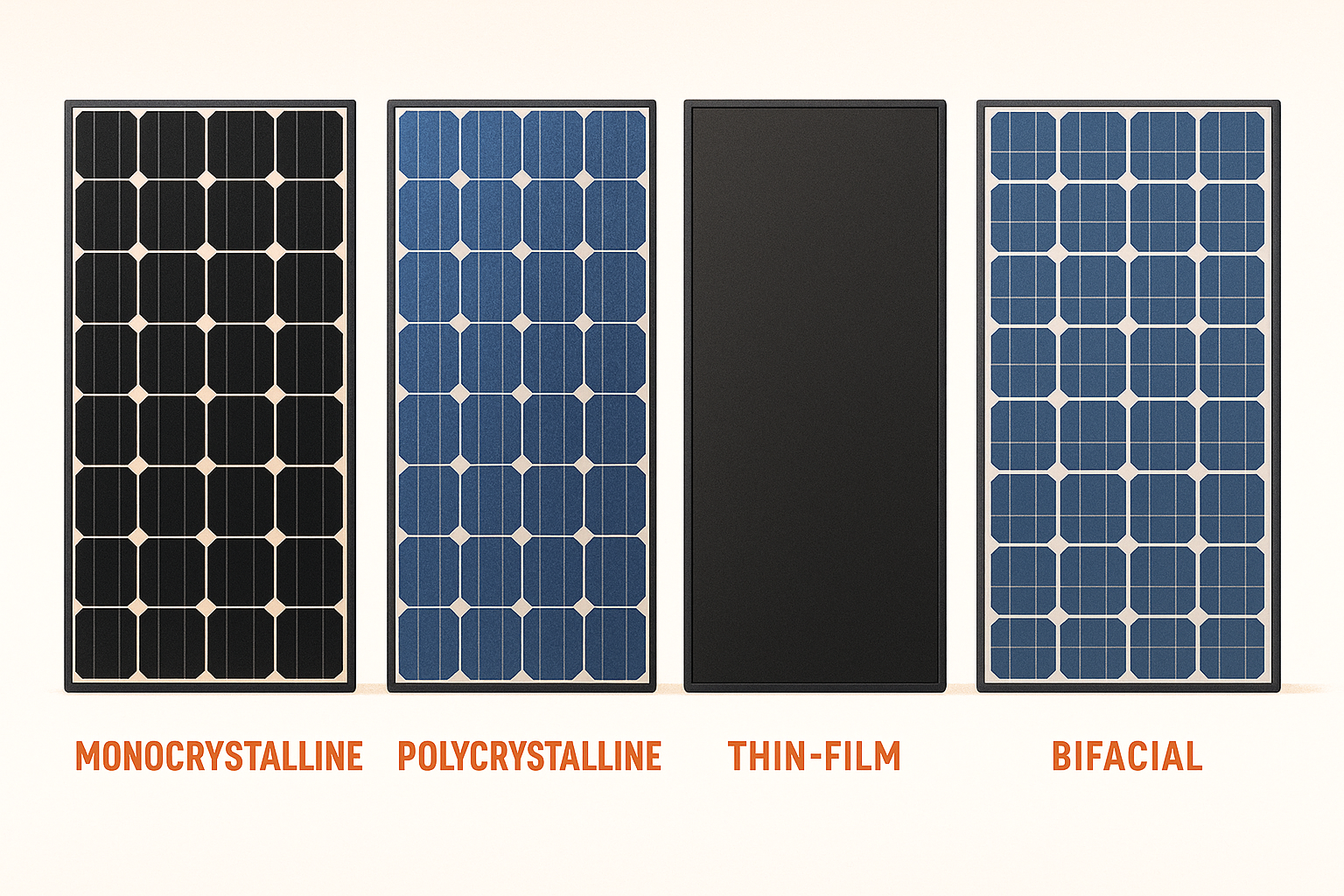
Comparison Table
| Feature | Monocrystalline (Mono PERC) | Polycrystalline | Thin-Film | Bifacial |
|---|---|---|---|---|
| Efficiency | 17--22% | 15--17% | 10--13% | Up to 22% (front) + 10--30% rear gain |
| Cost per Watt | Rs 28--35 | Rs 22--28 | Rs 20--25 | Rs 32--40 |
| Space per kW | ~60--70 sq ft | ~80--100 sq ft | ~100--120 sq ft | ~60--70 sq ft |
| Appearance | Black cells, sleek | Blue speckled | Uniform black/brown | Transparent back |
| Temperature Coefficient | -0.35%/C | -0.45%/C | -0.20%/C | -0.35%/C |
| Degradation Rate | ~0.5%/year | ~0.8%/year | ~0.5%/year | ~0.45%/year |
| Lifespan | 25--30 years | 25 years | 20--25 years | 25--30 years |
| Best For | Most homes, limited space | Budget-conscious buyers | Curved or lightweight roofs | Maximum generation, reflective surfaces |
Which Panel Should You Choose?
-
Monocrystalline (Mono PERC Half-Cut): This is the default recommendation for most Indian homes in 2026. High efficiency means you need fewer panels and less roof space. The lower temperature coefficient is a significant advantage in India's hot climate, where panel surface temperatures regularly exceed 45 degrees Celsius.
-
Polycrystalline: Once the budget choice, polycrystalline panels are now nearly obsolete for new residential installations. The efficiency gap versus mono PERC has widened, and the price difference has narrowed to a point where mono panels offer better long-term value.
-
Thin-Film: Rarely used for residential rooftops in India. They require almost double the space of mono panels for the same output. Their primary advantage is flexibility and light weight, making them suitable for unconventional surfaces like curved roofs or building facades.
-
Bifacial: The premium option. These panels generate electricity from both sides, capturing reflected light off your roof surface. On a white or light-coloured roof, bifacial panels can produce 10--30% more energy than standard mono panels. Ideal if you want maximum output from limited space and are willing to invest more upfront.
Our recommendation: For most homes in Dhule and Maharashtra, Mono PERC Half-Cut panels from an ALMM-listed manufacturer offer the best balance of efficiency, durability, and value.
System Types: On-Grid vs Off-Grid vs Hybrid
The type of solar system you choose determines whether you stay connected to the electricity grid, store power in batteries, or both.
Comparison Table
| Feature | On-Grid | Off-Grid | Hybrid |
|---|---|---|---|
| Grid Connection | Yes (required) | No | Yes |
| Battery Storage | No | Yes (mandatory) | Yes (optional) |
| Net Metering | Yes -- earn credits | Not applicable | Yes -- with battery backup |
| Power During Outage | No (shuts down) | Yes | Yes |
| Cost (3kW) | Rs 1,50,000 -- 1,80,000 | Rs 2,20,000 -- 2,70,000 | Rs 2,50,000 -- 3,20,000 |
| Cost (5kW) | Rs 2,30,000 -- 2,90,000 | Rs 3,50,000 -- 4,50,000 | Rs 3,80,000 -- 5,00,000 |
| PM Surya Ghar Subsidy | Eligible | Not eligible | Eligible (on-grid component) |
| Payback Period | 3--5 years | 6--10 years | 5--7 years |
| Best For | Urban homes with stable grid | Remote areas, no grid | Areas with frequent outages |
On-Grid (Grid-Tied) Systems
The most popular and cost-effective option for homes in Maharashtra. Your solar panels generate electricity during the day. Whatever you do not use gets pushed to the MSEDCL grid, spinning your meter backwards through net metering. At night, you draw power from the grid as usual.
Advantages: Lowest cost, fastest payback, full subsidy eligibility, no battery maintenance.
Limitation: When the grid goes down, your system shuts down too. This is a safety feature called anti-islanding that protects line workers from unexpected electricity on the grid.
Off-Grid Systems
Completely independent of the grid. All excess energy is stored in batteries for use at night or on cloudy days. These systems are typically used in remote areas where grid connectivity is unreliable or absent.
Advantages: Complete energy independence, works anywhere.
Limitation: Most expensive option due to battery costs, batteries need replacement every 5--8 years, not eligible for PM Surya Ghar subsidy.
Hybrid Systems
The best of both worlds. Connected to the grid with battery backup. During the day, solar powers your home. Excess goes to the battery first, then to the grid. At night, the battery kicks in before the grid takes over.
Advantages: Uninterrupted power during outages, smart energy management, future-proof as battery costs decline.
Limitation: Higher upfront cost, battery adds maintenance complexity.
Our recommendation: For most homes in Dhule and urban Maharashtra, an on-grid system offers the fastest payback and maximum savings. If you experience frequent power cuts (more than 2--3 hours daily), consider a hybrid system.
Understanding Solar Inverters
The inverter is the brain of your solar system. It converts the DC (direct current) electricity generated by your panels into AC (alternating current) that powers your home appliances.
String Inverters
The most common and affordable option. All panels in a string are connected in series to a single central inverter.
- Efficiency: 94--96%
- Cost: Rs 6--10 per watt
- Warranty: 5--12 years
- Best for: Simple roofs with uniform sunlight, no shading issues
How it works: If one panel in the string underperforms (due to shade, dirt, or a fault), the entire string's output drops to the weakest panel's level. Think of it like a chain -- only as strong as its weakest link.
Micro Inverters
Small individual inverters mounted behind each panel. Each panel operates independently.
- Efficiency: Up to 98%
- Cost: Rs 15--20 per watt
- Warranty: 25 years
- Best for: Roofs with partial shading, multiple orientations, or complex layouts
How it works: Each panel generates its maximum output regardless of what other panels are doing. Panel-level monitoring lets you track individual performance. If one panel is shaded, only that panel's output drops -- the rest continue at full capacity.
Hybrid Inverters
Combine a grid-tied inverter with a battery charge controller in a single unit.
- Efficiency: 93--96%
- Cost: Rs 12--18 per watt
- Warranty: 5--10 years
- Best for: Systems with battery storage, future battery upgrades
How it works: Manages power flow between panels, batteries, home loads, and the grid automatically. Prioritises self-consumption, then battery charging, then grid export.
Our recommendation: For most residential installations, a string inverter from a reputed brand (Fronius, SMA, Growatt, Havells, or Polycab) is the best value. If your roof has shading issues or complex geometry, micro inverters justify the extra cost.
Cost Breakdown: What Does Rooftop Solar Actually Cost?
This is the section most homeowners want to see first. Here is a realistic cost breakdown for on-grid rooftop solar systems in India as of early 2026, including the PM Surya Ghar subsidy calculation.
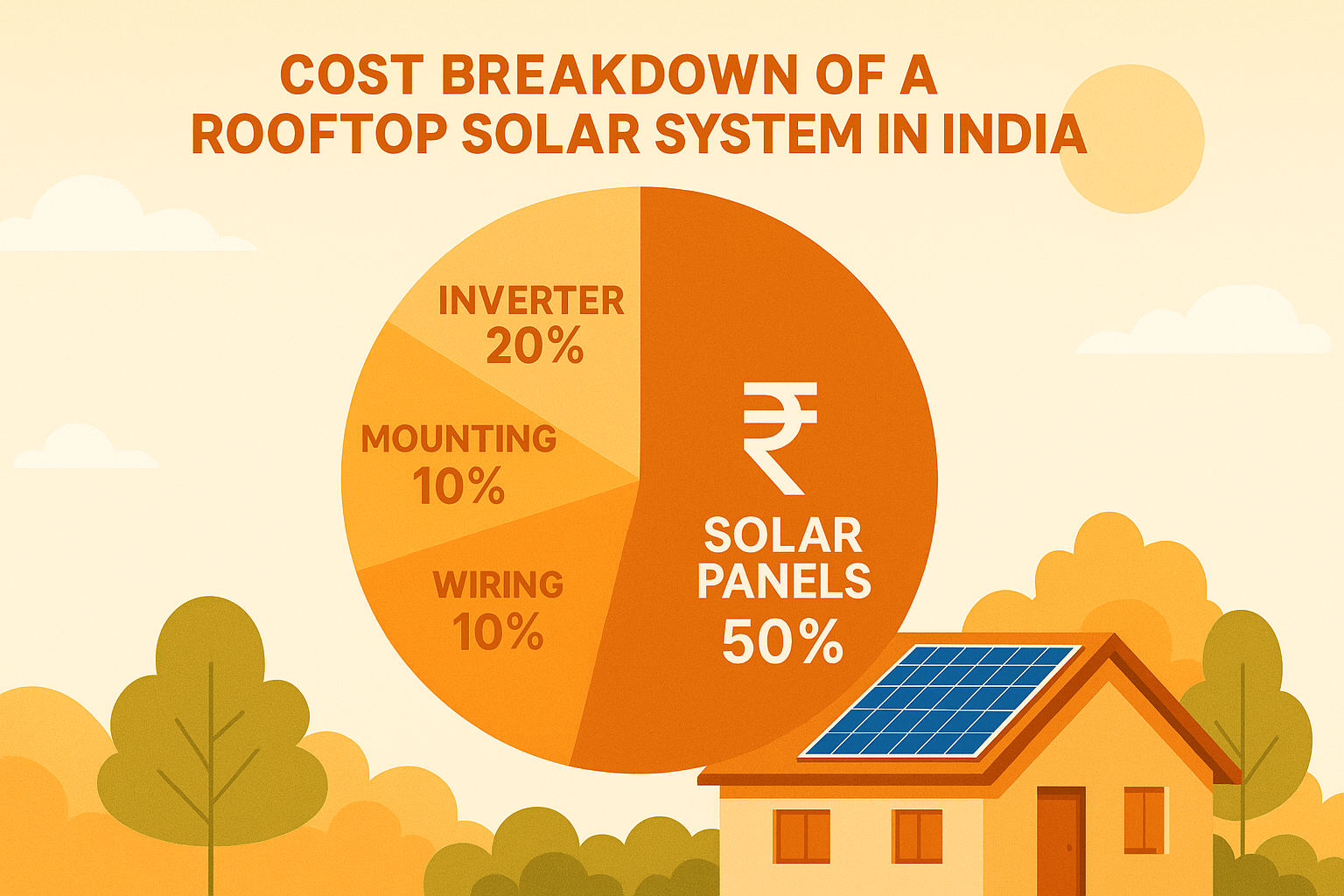
Price Table (On-Grid Systems, Before and After Subsidy)
| System Size | Cost Before Subsidy | PM Surya Ghar Subsidy | Your Cost After Subsidy | Annual Generation | Monthly Savings (approx.) |
|---|---|---|---|---|---|
| 1 kW | Rs 65,000 -- 85,000 | Rs 30,000 | Rs 35,000 -- 55,000 | 1,400 -- 1,600 units | Rs 900 -- 1,100 |
| 2 kW | Rs 1,20,000 -- 1,50,000 | Rs 60,000 | Rs 60,000 -- 90,000 | 2,800 -- 3,200 units | Rs 1,800 -- 2,100 |
| 3 kW | Rs 1,70,000 -- 2,15,000 | Rs 78,000 | Rs 92,000 -- 1,37,000 | 4,200 -- 4,800 units | Rs 2,800 -- 3,200 |
| 5 kW | Rs 2,50,000 -- 3,20,000 | Rs 78,000 | Rs 1,72,000 -- 2,42,000 | 7,000 -- 8,000 units | Rs 4,600 -- 5,300 |
| 10 kW | Rs 4,50,000 -- 5,50,000 | Rs 78,000 | Rs 3,72,000 -- 4,72,000 | 14,000 -- 16,000 units | Rs 9,300 -- 10,600 |
Note: Prices are indicative and vary by location, brand, and installer. Generation estimates are based on Maharashtra's average 4.5--5.0 peak sun hours. Monthly savings calculated at MSEDCL average tariff of ~Rs 8/unit.
PM Surya Ghar Subsidy Structure
The subsidy applies only to residential on-grid systems and is calculated as follows:
| Capacity | Subsidy Rate | Maximum Subsidy |
|---|---|---|
| Up to 2 kW | Rs 30,000 per kW | Rs 60,000 |
| 2 kW to 3 kW | Rs 18,000 per kW (for the portion above 2 kW) | Rs 78,000 total |
| Above 3 kW (up to 10 kW) | No additional subsidy | Rs 78,000 (capped) |
Important: The subsidy is transferred directly to your bank account within 30 days of successful installation and DISCOM (MSEDCL) approval. You pay the full amount to your installer upfront and receive the subsidy reimbursement afterwards.
What Is Included in the Cost?
A standard on-grid installation package typically includes:
- Solar panels (ALMM-listed, BIS-certified)
- Grid-tied string inverter
- Galvanised iron or aluminium mounting structure
- DC and AC cables, connectors, and conduit
- AC/DC distribution boxes with surge protection
- Earthing kit
- Net meter (provided by MSEDCL; connection charges apply separately)
- Installation labour
- 5-year comprehensive warranty on workmanship
- Assistance with MSEDCL net metering application
How to Calculate Your Ideal System Size
Choosing the right system size starts with your electricity bill. Here is a simple method:
Step 1: Find Your Monthly Consumption
Look at your MSEDCL electricity bill. Find the "Units Consumed" figure. Take an average of the last 12 months to account for seasonal variation.
Step 2: Match System Size to Consumption
| Monthly Consumption | Recommended System Size | Roof Space Needed |
|---|---|---|
| 100 -- 150 units | 1 kW | ~100 sq ft |
| 150 -- 250 units | 2 kW | ~200 sq ft |
| 250 -- 400 units | 3 kW | ~300 sq ft |
| 400 -- 600 units | 5 kW | ~500 sq ft |
| 600 -- 800 units | 7 kW | ~700 sq ft |
| 800 -- 1,200 units | 10 kW | ~1,000 sq ft |
Step 3: The Quick Formula
System Size (kW) = Monthly Units / (Peak Sun Hours x 30 x 0.8)
For Maharashtra, with average peak sun hours of 4.8:
System Size = Monthly Units / (4.8 x 30 x 0.8)
System Size = Monthly Units / 115.2
Example: If your monthly consumption is 350 units:
System Size = 350 / 115.2 = 3.04 kW ≈ 3 kW system
The 0.8 factor accounts for real-world losses from dust, temperature, wiring, and inverter conversion.
Pro tip: Do not oversize your system beyond your consumption unless you plan to add electric vehicles, heat pumps, or other high-draw appliances soon. With net metering, excess units get credited at a lower rate (around Rs 2.82/unit as per MERC's 2025-26 tariff order) than what you pay for grid power (Rs 8+/unit).
Want to calculate your exact savings? Use our Solar Savings Calculator with Maharashtra-specific data for all 11 major districts.
Roof Requirements: Is Your Roof Solar-Ready?
Before any installation, your roof needs to meet certain conditions.
Space
As a rule of thumb, you need approximately 100 square feet of shadow-free rooftop area per kW of solar panels on an RCC (concrete) roof. For a standard 3 kW system, that means about 300 square feet of clear space.
For tin or sheet-metal roofs, panels are mounted flat with clamps, which may require slightly less space but offer suboptimal tilt angles.
Orientation
In India (Northern Hemisphere), panels should face true south for maximum energy generation throughout the year. Panels facing south-east or south-west still perform well, losing only about 5--10% generation compared to true south. East or west-facing panels lose about 15--20%.
North-facing panels are not recommended and will significantly underperform.
Tilt Angle
The optimal tilt angle varies by your latitude:
| Region | Recommended Tilt | Example Cities |
|---|---|---|
| Southern India | 10--15 degrees | Chennai, Bangalore, Hyderabad |
| Central India (Maharashtra) | 15--20 degrees | Dhule, Nashik, Pune, Mumbai |
| Northern India | 25--30 degrees | Delhi, Jaipur, Lucknow |
For Dhule (latitude ~20.9 degrees N), a tilt of 18--20 degrees is optimal. Most mounting structures come with adjustable tilt, and your installer will set this during installation.
Shadow Analysis
This is critical. Even partial shading on one panel can reduce the output of an entire string. Common sources of shadow:
- Water tanks and overhead tanks
- Adjacent buildings or walls
- Trees (consider seasonal growth)
- Satellite dishes, antennas, chimneys
- Parapet walls (especially on low-rise buildings)
A good installer will perform a shadow analysis at your site, checking for obstructions during different times of day and seasons. The minimum requirement is shadow-free sunlight from 9 AM to 4 PM.
Structural Load
Solar panels with mounting structures add approximately 15--20 kg per square metre to your roof. An RCC roof can typically handle this without any reinforcement. However, if your roof is old, damaged, or made of lightweight material (asbestos sheets, tin), a structural assessment may be necessary.
Step-by-Step Installation Process
Here is exactly what happens from the moment you decide to go solar to the day your system starts generating electricity.
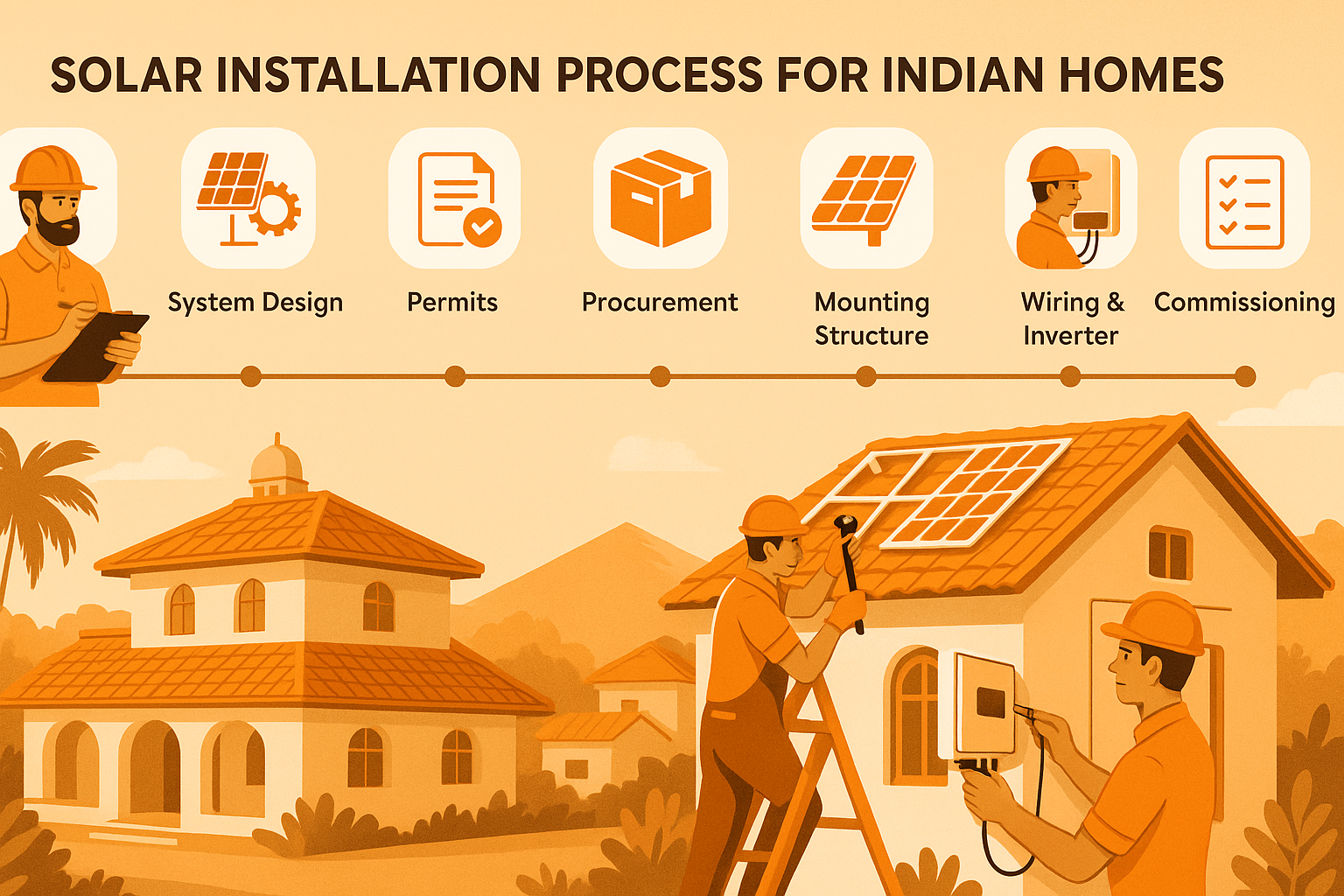
Step 1: Initial Inquiry and Site Survey (Day 1--3)
Contact a solar installer (like AceSolarTech) for a free consultation. An engineer visits your site to assess:
- Roof type, area, orientation, and tilt potential
- Shadow obstructions throughout the day
- Existing electrical setup (single/three phase, meter type)
- Your electricity consumption patterns
- Structural integrity of the roof
Step 2: System Design and Quotation (Day 3--7)
Based on the site survey, the installer prepares:
- A customised system design with panel layout
- Equipment specifications (panel brand, inverter model)
- A detailed cost quotation with and without subsidy
- Expected generation and savings projections
- Warranty terms and maintenance plan
Step 3: PM Surya Ghar Application (Day 7--14)
Register on the national portal at pmsuryaghar.gov.in. Your installer typically helps with this process:
- Create an account using your electricity consumer number
- Upload required documents (ID proof, electricity bill, bank details, roof photos)
- Select your preferred system size and vendor
- Receive a feasibility approval from MSEDCL (within 7 working days)
Step 4: Purchase and Procurement (Day 14--21)
Once feasibility is approved:
- Sign the installation agreement
- Make the payment (full system cost; subsidy is reimbursed later)
- Installer procures ALMM-listed panels, BIS-certified inverter, and mounting hardware
Step 5: Physical Installation (Day 21--24)
The actual installation takes 1--3 days for residential systems:
- Mounting structure installation: Galvanised iron or aluminium frames are bolted to the roof with weatherproof fasteners
- Panel mounting: Solar panels are secured to the frame at the optimal tilt angle
- Electrical wiring: DC cables from panels to the inverter, AC cables from the inverter to your distribution board
- Inverter installation: Wall-mounted near the main switchboard, in a shaded, ventilated location
- Earthing: Proper earthing of the mounting structure, panels, and inverter for safety
- Testing: System commissioning checks including voltage, current, insulation resistance, and earth continuity
Step 6: MSEDCL Inspection and Net Meter Installation (Day 24--45)
After installation:
- The installer submits commissioning documents to MSEDCL
- MSEDCL conducts a site inspection
- A bidirectional (net) meter is installed
- MSEDCL issues a commissioning certificate
This step can take 2--4 weeks depending on MSEDCL's processing timeline in your area.
Step 7: Subsidy Disbursement (Day 45--75)
After successful commissioning:
- Upload the commissioning certificate and net meter photos on the PM Surya Ghar portal
- Your application is verified by the DISCOM and MNRE
- The subsidy amount is transferred directly to your bank account within 30 days
Step 8: Start Saving
Your system is now live. Monitor your generation through the inverter's app or display. Enjoy watching your electricity bill shrink month after month.
Total timeline from inquiry to commissioning: approximately 4--8 weeks, depending on equipment availability and MSEDCL processing speed.
Understanding Net Metering in Maharashtra (MSEDCL)
Net metering is the mechanism that makes on-grid solar financially viable. Here is how it works with MSEDCL.
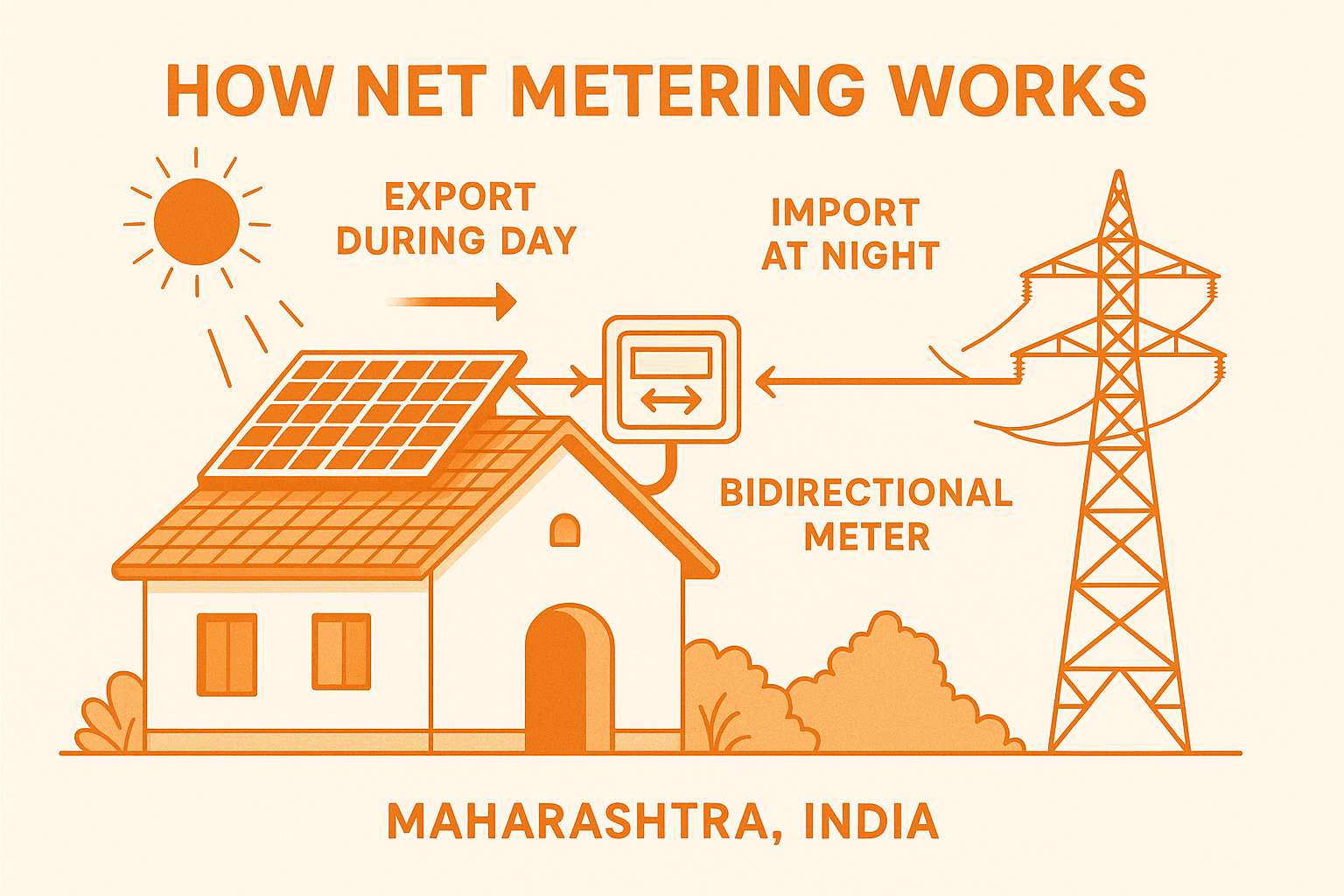
How Net Metering Works
-
During the day: Your solar panels generate electricity. Whatever your home does not consume at that moment gets exported to the MSEDCL grid. Your bidirectional meter records the export.
-
At night / cloudy periods: You draw electricity from the grid as usual. The meter records the import.
-
Monthly settlement: MSEDCL calculates the difference:
- If you consumed more than you generated: you pay for the net difference at the normal tariff
- If you generated more than you consumed: the excess units are carried forward as credits to the next billing cycle
-
Annual settlement: At the end of the settlement period (typically March), any remaining excess credits are compensated at the rate determined by MERC (approximately Rs 2.82/unit as per the 2025-26 tariff order).
Key Rules for Maharashtra
- Capacity limit: Rooftop solar capacity cannot exceed your sanctioned load or the capacity of your distribution transformer's allocation, whichever is lower
- Eligibility: Available to all residential, commercial, and industrial MSEDCL consumers
- Meter: MSEDCL provides and installs the bidirectional meter (a nominal fee applies)
- Billing: Net metering is adjusted in your regular monthly MSEDCL bill
- Virtual Net Metering (VNM): Multiple consumers in a housing society can share a single rooftop solar plant, with credits distributed proportionally
- Open Access + Net Metering: MERC now allows consumers to simultaneously avail open access and net metering
MSEDCL Application Process
- Visit the MSEDCL Green Energy portal or your nearest MSEDCL office
- Submit the net metering application with your installation details
- MSEDCL conducts a feasibility study (within 7 working days)
- Upon approval, proceed with installation
- After installation, MSEDCL inspects and installs the net meter
ROI and Payback Period: The Real Numbers
Let us work through a concrete example for a typical Dhule household.
Example: 3 kW On-Grid System in Dhule, Maharashtra
Investment:
| Item | Amount |
|---|---|
| System cost (3 kW on-grid) | Rs 1,90,000 |
| PM Surya Ghar subsidy | - Rs 78,000 |
| Net investment | Rs 1,12,000 |
Annual Returns:
| Item | Calculation | Amount |
|---|---|---|
| Annual generation | 3 kW x 4.8 sun hours x 365 x 0.80 | ~4,200 units/year |
| Grid tariff saved | 4,200 units x Rs 8/unit | Rs 33,600/year |
| Maintenance cost | Annual cleaning and inspection | - Rs 3,000/year |
| Net annual savings | Rs 30,600/year |
Payback Calculation:
Payback Period = Net Investment / Net Annual Savings
Payback Period = Rs 1,12,000 / Rs 30,600
Payback Period = 3.66 years (approximately 3 years 8 months)
25-Year Financial Summary:
| Metric | Value |
|---|---|
| Total investment (after subsidy) | Rs 1,12,000 |
| Total savings over 25 years* | Rs 7,65,000+ |
| Return on Investment (ROI) | ~580% |
| Average annual return | ~23% |
| Break-even point | Year 4 |
Accounting for 0.5% annual panel degradation and assuming a conservative 3% annual increase in grid tariffs.
In plain language: You invest Rs 1.12 lakh out of pocket and get it back within 4 years. For the remaining 21+ years of the system's life, you generate free electricity. Over the full 25 years, you save over Rs 7.5 lakh -- that is nearly 7 times your investment.
Factors That Improve Your ROI
- Higher electricity consumption (higher tariff slabs mean bigger savings per unit)
- South-facing roof with no shading
- Regular panel cleaning (dusty panels lose 10--25% output)
- High-efficiency mono PERC or bifacial panels
- Increasing grid tariffs over time (historically 3--5% annual increase)
Factors That Reduce Your ROI
- Partial shading on panels
- East/west roof orientation
- Low electricity consumption (smaller tariff savings per unit)
- Irregular maintenance and cleaning
Top Solar Panel Brands in India (2026)
Choosing the right brand matters. Here are the leading manufacturers with a track record in India, all listed on MNRE's ALMM (Approved List of Models and Manufacturers).
Brand Comparison Table
| Brand | Manufacturing Capacity | Panel Types | Efficiency Range | Warranty | Price Range (per Watt) | Strengths |
|---|---|---|---|---|---|---|
| Tata Power Solar | 1.1 GW | Mono PERC, Bifacial | 19--21.5% | 25-year performance | Rs 28--34 | Best after-sales service, trusted brand |
| Waaree Energies | 12 GW | Mono PERC, Bifacial, TOPCon | 20--22% | 25-year performance | Rs 26--33 | India's largest manufacturer, competitive pricing |
| Adani Solar | 10 GW (by mid-2026) | Mono PERC, Bifacial, HJT | 20--22.5% | 25-year performance | Rs 27--34 | Massive scale, cutting-edge technology |
| Vikram Solar | 1+ GW | Mono PERC, Bifacial, Glass-Glass | 20--21.5% | 25-year performance | Rs 28--33 | High-efficiency specialist, award-winning |
| Luminous (Schneider) | 1 GW | Mono PERC, Polycrystalline | 18--21% | 25-year performance | Rs 25--30 | Strong distribution network, affordable |
| Havells | 500 MW | Mono PERC | 19--20.5% | 25-year performance | Rs 28--32 | Trusted electrical brand, good support |
| Goldi Solar | 2.5 GW | Mono PERC, Bifacial, TOPCon | 20--22% | 25-year performance | Rs 25--31 | Fast-growing Gujarat manufacturer |
| Premier Energies | 2 GW (cells + modules) | Mono PERC, TOPCon | 20--22% | 25-year performance | Rs 27--33 | Vertically integrated, cell manufacturer |
How to Choose a Brand
-
ALMM compliance is non-negotiable. Only ALMM-listed panels are eligible for PM Surya Ghar subsidy and net metering in India. As of January 2025, there are 100 enlisted manufacturers.
-
Check BIS certification. All solar panels sold in India must carry the BIS (Bureau of Indian Standards) mark under the Compulsory Registration Scheme. This ensures compliance with IS 14286 standards for safety and performance. Minimum efficiency thresholds are 18% for monocrystalline and 17% for polycrystalline panels.
-
Prioritise performance warranty. All major brands offer a 25-year performance warranty guaranteeing at least 80% of rated output after 25 years. The product (defect) warranty varies from 10 to 15 years. Longer product warranties indicate manufacturer confidence.
-
Consider local availability. Panels from manufacturers with strong distribution in Maharashtra (Waaree, Tata, Luminous) typically mean faster replacement and service if issues arise.
Our recommendation at AceSolarTech: We work with multiple ALMM-listed brands and recommend the best option based on your budget, roof conditions, and performance goals. Every panel we install is BIS-certified and backed by a 25-year manufacturer warranty.
Maintenance Guide: Keeping Your System at Peak Performance
Rooftop solar systems are remarkably low-maintenance, but a little care goes a long way.
Cleaning Schedule
| Environment | Cleaning Frequency | Estimated Cost |
|---|---|---|
| Dusty areas (near highways, construction, farmland) | Every 1--2 months | Rs 500--1,000 per cleaning |
| Normal urban/suburban | Every 2--3 months (4--6 times/year) | Rs 500--1,000 per cleaning |
| Clean areas (minimal dust) | Every 3--4 months (3--4 times/year) | Rs 500--1,000 per cleaning |
| After dust storms, heavy rains, or bird droppings | Immediately | As needed |
Cleaning tips:
- Use plain water and a soft cloth or sponge. Avoid abrasive materials.
- Clean early morning or late evening when panels are cool. Spraying cold water on hot panels can cause thermal shock and micro-cracks.
- Never use soap, detergent, or chemical cleaners as they can leave residue that attracts more dust.
- If your roof is accessible, you can do it yourself. Otherwise, hire a professional.
Annual Inspection Checklist
- Check all cable connections for looseness or corrosion
- Inspect the mounting structure for rust or bolt loosening
- Verify inverter operation and error codes
- Check earthing continuity
- Review generation data against expected output
- Inspect for any new shadow obstructions (new construction, tree growth)
Annual Maintenance Cost
For residential systems, expect to spend Rs 2,000--5,000 per year on maintenance, covering periodic cleaning and an annual professional inspection. Many installers offer Annual Maintenance Contracts (AMC) that include scheduled cleaning visits, inverter health checks, and priority support.
Monitoring
Most modern inverters come with Wi-Fi-enabled apps that let you track daily, monthly, and annual generation from your phone. Set up alerts for unusual drops in output, which could indicate panel soiling, shading issues, or equipment faults.
Rule of thumb: A well-maintained system in Maharashtra should generate approximately 1,300--1,500 units per kW per year. If your generation falls more than 15% below this benchmark, investigate.
Frequently Asked Questions
1. How long do solar panels last?
Solar panels are designed to last 25--30 years. Most manufacturers guarantee at least 80% of rated output after 25 years. In practice, many panels continue producing well beyond their warranty period. The inverter may need replacement once during the system's lifetime (after 12--15 years for string inverters).
2. Will solar panels work on cloudy days or during monsoon?
Yes, but at reduced output. Solar panels generate electricity from light, not direct sunlight. On cloudy days, expect 20--40% of peak output. During monsoon months (June--September) in Maharashtra, monthly generation typically drops by 30--50% compared to peak summer months. Your system is sized to account for this seasonal variation over the full year.
3. Can I install solar on a rented property?
Technically yes, but the PM Surya Ghar subsidy requires the applicant to be the electricity consumer (the person whose name is on the MSEDCL bill). You would need the property owner's consent and cooperation. For tenants, it is usually better to encourage the landlord to install the system.
4. What happens to solar panels during heavy rain or hailstorms?
Solar panels are built to withstand extreme weather. They are tested to endure hail impact (25mm ice balls at 80 km/h) and wind loads up to 2,400 Pascals. The tempered glass surface is robust enough to handle heavy rainfall. Properly installed mounting structures can withstand wind speeds of up to 150 km/h.
5. Do I need to upgrade my electrical wiring for solar?
In most cases, your existing wiring is sufficient for systems up to 3 kW. For larger systems (5 kW and above), your installer may recommend upgrading your main distribution board or certain circuits. The installer will assess this during the site survey.
6. Can I expand my solar system later?
Yes. You can add more panels in the future, subject to available roof space and your sanctioned load. However, you will need to update your net metering agreement with MSEDCL. String inverters may need to be upsized. Micro inverter systems are easier to expand since each panel operates independently.
7. What is the difference between ALMM and BIS certification?
BIS certification (Bureau of Indian Standards) certifies that a solar panel meets Indian safety and performance standards (IS 14286). It is mandatory for all panels sold in India.
ALMM (Approved List of Models and Manufacturers) is maintained by MNRE and lists panels that are approved for use in government-subsidised projects, net metering, and open access installations. Being on the ALMM list requires additional compliance beyond BIS. Always choose panels that are both BIS-certified and ALMM-listed.
8. How much can I save on my electricity bill?
A correctly sized system can offset 70--100% of your electricity bill. For example, a 3 kW system in Dhule generating ~4,200 units/year would offset a monthly consumption of about 350 units, saving approximately Rs 2,500--3,000 per month at current MSEDCL rates.
9. Is solar installation safe for my roof? Will it cause leaks?
Professional installers use non-penetrating mounting systems or seal all roof penetrations with weatherproof flashings and sealants. When installed correctly, solar panels actually protect your roof surface from direct sun and rain, potentially extending its life. Always choose an experienced, certified installer.
10. What financing options are available for solar installation?
Several options exist:
- PM Surya Ghar subsidy: Up to Rs 78,000 direct reimbursement
- Solar loans: Many banks (SBI, Bank of Baroda, Canara Bank) offer dedicated solar loans at 7--9% interest rates with tenures of 3--7 years
- EMI options: Some installers offer 0% EMI for 6--12 months through fintech partnerships
- Green bonds and NABARD refinancing: Available for agricultural solar installations
11. Can I sell excess electricity to MSEDCL?
Through net metering, excess units are first carried forward as credits. At the annual settlement (March), unadjusted credits are compensated at the MERC-determined rate (approximately Rs 2.82/unit in 2025-26). While this is lower than the retail tariff, most well-sized systems aim to consume most of their generation, minimising excess.
12. How do I verify if a solar company is genuine?
- Check if they are registered on the PM Surya Ghar portal as an approved vendor
- Verify their MSEDCL empanelment
- Ask for ALMM-listed panel brands and BIS certification documents
- Request references from previous installations in your area
- Check for a physical office address and valid GST registration
Ready to Go Solar?
Rooftop solar is not just an environmental choice -- it is one of the smartest financial decisions you can make for your home. With panel prices at historic lows, government subsidies at their peak, and electricity tariffs climbing every year, the return on investment has never been better.
At AceSolarTech, we specialise in residential and commercial rooftop solar installations across Dhule and Maharashtra. From site survey to MSEDCL net metering approval, we handle every step of the process.
Here is what we offer:
- Free site survey and customised system design
- ALMM-listed, BIS-certified panels from top Indian brands
- End-to-end installation with MSEDCL net metering support
- PM Surya Ghar subsidy application assistance
- 5-year comprehensive workmanship warranty
- Post-installation maintenance and monitoring support
Calculate your savings now with our Solar Savings Calculator -- it uses Maharashtra-specific solar data for all 11 major districts, including Dhule, Nashik, Pune, Jalgaon, and more.
Get a free quote today. Reach out to us on WhatsApp and our team will get back to you within 24 hours with a personalised proposal for your rooftop.
Disclaimer: Prices, subsidy rates, and regulations mentioned in this article are accurate as of February 2026 and are subject to change. The PM Surya Ghar scheme is a Government of India initiative and subsidy disbursement is subject to government guidelines and fund availability. Actual generation and savings will vary based on your specific location, roof conditions, consumption patterns, and system configuration. Always consult with a certified solar installer for accurate estimates tailored to your property.