

KUSUM Yojana 2026: How Maharashtra Farmers Can Get Solar Pumps with Up to 90% Subsidy
If you are a farmer in Maharashtra, you already know the two biggest headaches of irrigation: expensive diesel and unreliable electricity. Diesel prices have crossed Rs 90 per litre, and running a 5 HP diesel pump for 6-8 hours a day can easily cost Rs 500-700 daily. That adds up to Rs 60,000-80,000 per year just on fuel. And if you depend on MSEDCL grid power, you know the story — load-shedding during the day when you actually need water, and electricity arriving at 2 AM when your crops are sleeping.
The good news? The Government of India and Maharashtra State Government together offer a solution that can eliminate your diesel costs forever and give you reliable daytime irrigation: the PM-KUSUM Yojana (Pradhan Mantri Kisan Urja Suraksha evam Utthaan Mahabhiyan) and its Maharashtra state counterpart, the Mukhyamantri Saur Krushi Pump Yojana.
Under these schemes, Maharashtra farmers can get solar-powered irrigation pumps with up to 90-95% government subsidy — meaning you pay as little as 5-10% of the total cost. A solar pump that costs Rs 2-3 lakh could be yours for just Rs 15,000-25,000.
In this complete guide, we explain everything a Maharashtra farmer needs to know: what the KUSUM Yojana is, how much subsidy you get, which pump size is right for your farm, how to apply, and how AceSolarTech can handle the entire process for you.
What is PM-KUSUM Yojana?
The Pradhan Mantri Kisan Urja Suraksha evam Utthaan Mahabhiyan (PM-KUSUM) was launched by the Ministry of New and Renewable Energy (MNRE) in March 2019. The scheme aims to add 34,800 MW of solar capacity across India by March 2026, with a central financial allocation of Rs 34,422 crore.
The scheme has three components, each designed to help farmers in different ways:
Component A: Solar Power Plants on Farm Land (10,000 MW)
Under Component A, farmers, cooperatives, panchayats, and farmer producer organizations (FPOs) can install ground-mounted or stilt-mounted solar power plants on their barren or fallow land. These plants are connected to the grid, and the local DISCOM (in Maharashtra, MSEDCL) signs a 25-year Power Purchase Agreement (PPA) to buy the power at a fixed Feed-in Tariff.
What farmers earn: Farmers leasing barren land to solar developers can earn up to Rs 80,000 per hectare per year as rental income — without lifting a finger.
Component B: Standalone Solar Water Pumps (14 Lakh Pumps)
This is the most popular component for individual farmers. Under Component B, standalone off-grid solar water pumps of 3 HP, 5 HP, 7.5 HP, and 10 HP capacity are installed to replace diesel pumps. These pumps work independently — no grid connection needed. The sun powers them directly.
Subsidy: 60% government subsidy (30% Central + 30% State), with the remaining 40% split between farmer contribution and bank loan.
In FY2024-25, 4.4 lakh pumps were installed under Component B — a 4.2x increase over the previous year.
Component C: Solarisation of Grid-Connected Pumps (35 Lakh Pumps)
If you already have a grid-connected electric pump, Component C helps you add solar panels to that existing pump. The surplus power your solar panels generate can be sold back to MSEDCL, giving you extra income.
This component has two sub-modes:
- Individual pump solarisation — solar panels on your individual pump
- Feeder-level solarisation — entire agricultural feeders are converted to solar power through the Mukhyamantri Saur Krushi Vahini Yojana (MSKVY)
In FY2024-25, 2.6 lakh pumps were solarized under Component C — a 25x increase over FY2023-24.
Maharashtra-Specific Schemes: Double the Benefit
Maharashtra farmers are among the most fortunate when it comes to solar pump subsidies. The state runs two additional schemes on top of PM-KUSUM:
1. Mukhyamantri Saur Krushi Pump Yojana (MSKPY)
Also known as the Atal Saur Krishi Pump Yojana, this scheme targets farmers who do not have any existing electrical connection for irrigation. Maharashtra has committed to distributing 1,00,000 solar pumps to farmers under this scheme.
Subsidy: Up to 90-95% of the pump cost is covered by the government.
2. Magel Tyala Saur Krushi Pump Yojana
Translating to "Solar Pump for Whoever Asks", this is Maharashtra's ambitious expansion scheme with a budget of Rs 15,000 crore to provide solar pumps to 8.5 lakh farmers. The demand is so high that new batches of 10,000 pumps get booked within hours of opening.
3. Mukhyamantri Saur Krushi Vahini Yojana 2.0 (MSKVY)
This scheme focuses on feeder-level solarisation — installing solar power plants to supply dedicated daytime power to agricultural feeders. The target is 7,000 MW of decentralized solar projects with capacities ranging from 0.5 MW to 25 MW.
Subsidy Breakdown: How Much Do You Actually Pay?
This is what every farmer wants to know. Here is the subsidy structure for Maharashtra:
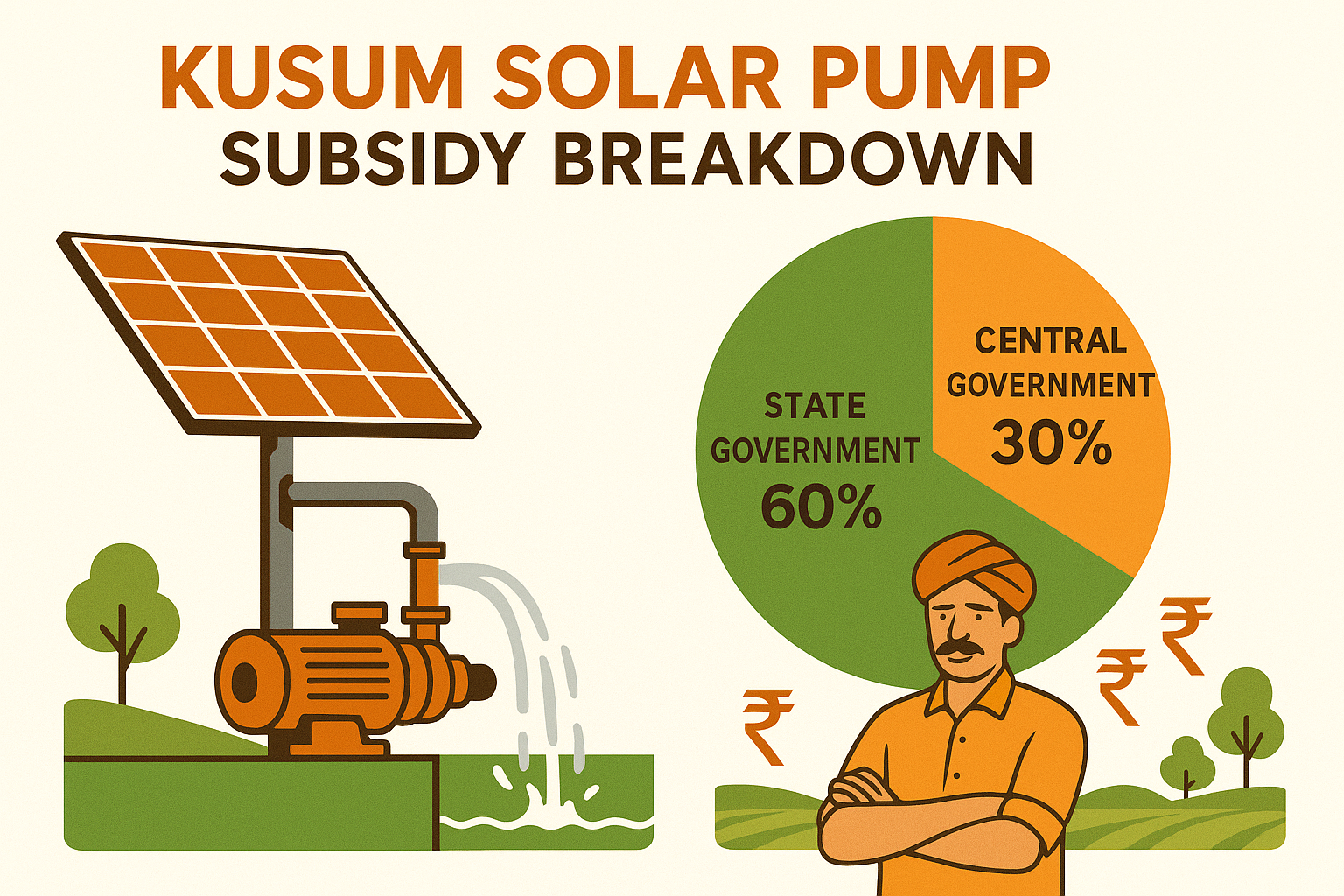
Under Mukhyamantri Saur Krushi Pump Yojana (Standalone Pumps)
| Component | Share |
|---|---|
| Central Government (MNRE) | 30% of benchmark cost |
| Maharashtra State Government | 60% of benchmark cost |
| Farmer (General Category) | 10% only |
| Farmer (SC/ST Category) | 5% only |
Estimated Cost by Pump Size (Maharashtra, 2025-26)
| Pump Capacity | Approximate Total Cost | General Farmer Pays (10%) | SC/ST Farmer Pays (5%) |
|---|---|---|---|
| 3 HP | Rs 1,80,000 - 2,10,000 | Rs 18,000 - 21,000 | Rs 9,000 - 10,500 |
| 5 HP | Rs 2,50,000 - 3,00,000 | Rs 25,000 - 30,000 | Rs 12,500 - 15,000 |
| 7.5 HP | Rs 3,50,000 - 4,20,000 | Rs 35,000 - 42,000 | Rs 17,500 - 21,000 |
Note: Actual benchmark costs are set by MNRE and may be updated. Contact AceSolarTech for the latest pricing applicable in Dhule and surrounding districts.
Under PM-KUSUM Component B (National Scheme)
| Component | Share |
|---|---|
| Central Government (MNRE) | 30% of benchmark cost |
| State Government | 30% of benchmark cost |
| Bank Loan (available) | 30% (repayable over 7 years) |
| Farmer | 10% only |
Under PM-KUSUM Component C (Grid-Connected Pump Solarisation)
| Pump Capacity | Solar Panel Size | Approximate Cost | Farmer Pays (10%) |
|---|---|---|---|
| 3 HP | 4.5 kW panels | Rs 2,50,000 | Rs 25,000 |
| 5 HP | 7.5 kW panels | Rs 4,40,000 | Rs 44,000 |
| 7.5 HP | 11.2 kW panels | Rs 6,23,000 | Rs 62,300 |
Under Component C, farmers can sell surplus solar electricity to MSEDCL and earn additional income.
Diesel Pump vs Solar Pump: The Real Cost Comparison
Let us compare what a farmer actually spends over 10 years with a diesel pump versus a solar pump:
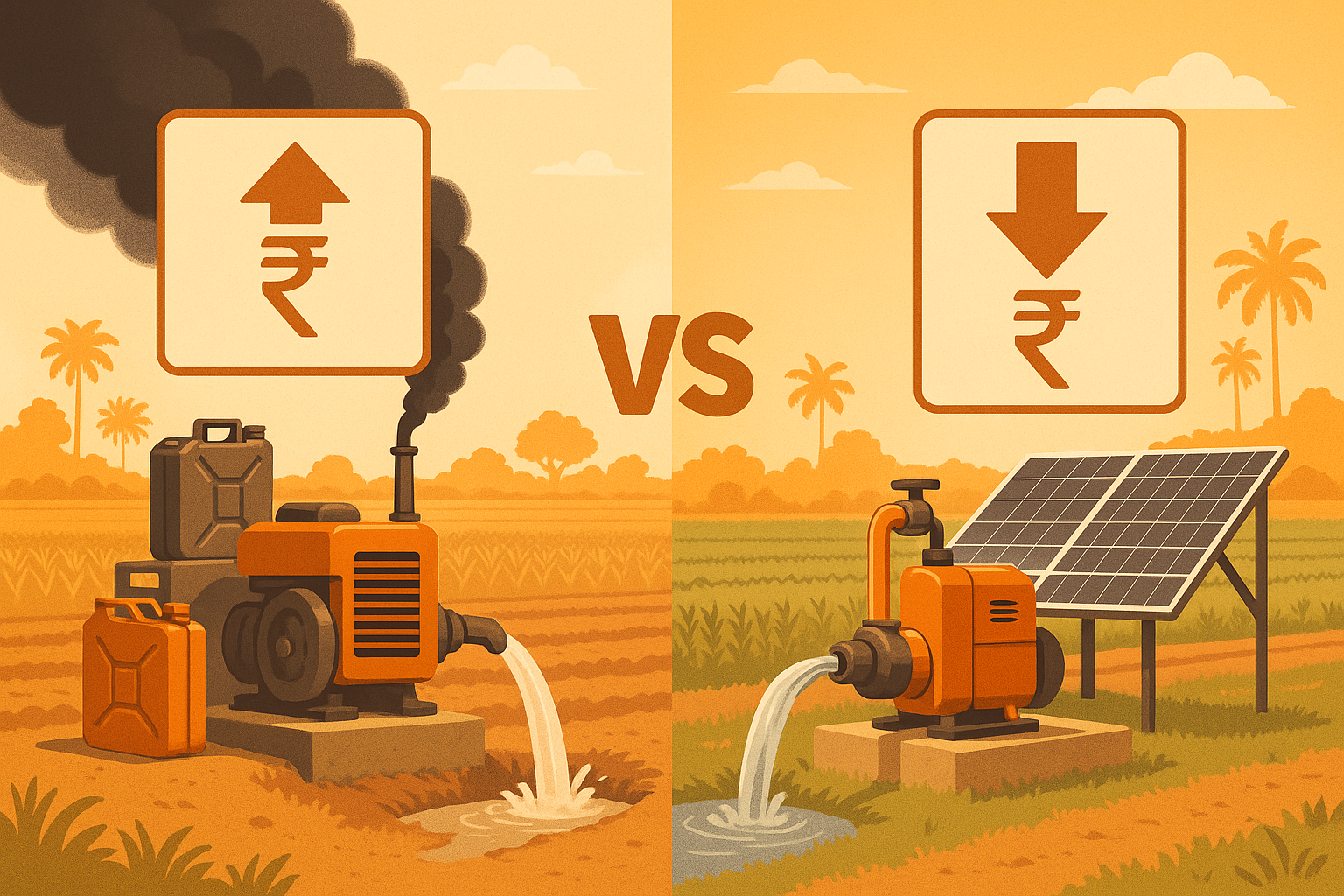
5 HP Pump — 10-Year Cost Comparison
| Cost Item | Diesel Pump | Solar Pump (after 90% subsidy) |
|---|---|---|
| Purchase cost | Rs 30,000 - 50,000 | Rs 25,000 - 30,000 (farmer share) |
| Annual fuel/electricity | Rs 60,000 - 80,000 | Rs 0 (free solar energy) |
| Annual maintenance | Rs 8,000 - 12,000 | Rs 2,000 - 3,000 |
| 10-year fuel cost | Rs 6,00,000 - 8,00,000 | Rs 0 |
| 10-year maintenance | Rs 80,000 - 1,20,000 | Rs 20,000 - 30,000 |
| Total 10-year cost | Rs 7,10,000 - 9,70,000 | Rs 47,000 - 63,000 |
| 10-year savings | — | Rs 6,50,000 - 9,00,000+ |
Key Facts:
- A 5 HP diesel pump consumes 4.6 litres of diesel daily
- At Rs 90+ per litre, that is Rs 414 per day or Rs 12,000+ per month during irrigation season
- Solar pump has zero fuel cost — the sun is free
- Solar panels last 25 years, pump motor has 5-year warranty
- Farmer recovers the initial 10% investment within 1-2 seasons
Which Pump Size is Right for Your Farm?
Choosing the correct pump capacity depends on your landholding, water source depth, and crop type:
| Pump Capacity | Suitable Land Size | Water Output | Well Depth | Best For |
|---|---|---|---|---|
| 3 HP | Up to 2.5 acres | 50,000 - 80,000 litres/day | Up to 30 metres | Small vegetable farms, drip irrigation, small paddy fields |
| 5 HP | 2.5 - 5 acres | 80,000 - 1,30,000 litres/day | Up to 50 metres | Medium farms, sugarcane, cotton, soybean |
| 7.5 HP | Above 5 acres | 1,30,000 - 2,00,000 litres/day | Up to 70 metres | Large farms, multiple crops, deep borewells |
| 10 HP | Above 8 acres | 2,00,000+ litres/day | Up to 100 metres | Very large holdings, commercial agriculture, horticulture |
Tip for Dhule District Farmers
Dhule district receives 4.8-5.1 peak sun hours per day on average, which is excellent for solar pumps. A 5 HP solar pump in Dhule will give you strong output for 6-7 hours of pumping daily during the rabi and kharif seasons.
Eligibility: Who Can Apply?
Basic Eligibility Checklist
- You are a resident of Maharashtra
- You own agricultural land with clear land records (7/12 extract)
- You have a permanent water source — well (vihar), borewell (kupnalika), farm pond, or canal access
- You do NOT have an existing electric pump connection from MSEDCL
- You have NOT received a solar pump under any previous government scheme
- Your water source is in a safe watershed zone (Stage of Development less than 60% as per GSDA — Groundwater Surveys and Development Agency)
Priority Categories (Higher Chance of Selection)
- Farmers in tribal and remote areas
- Farmers in villages not electrified by MSEDCL
- Beneficiaries of Dhadak Sinchan Yojana (drip irrigation scheme)
- Farmers who have applied for new MSEDCL connections but have not received them
- SC/ST category farmers (get 95% subsidy — only 5% farmer share)
Who Cannot Apply
- Farmers who already have an electric pump connection for agriculture
- Farmers who already received a solar pump under any government scheme
- Wells and borewells in over-exploited or critically exploited watershed villages (as classified by GSDA)
Documents Required
Gather these documents before you start your application:
Essential Documents
| Document | Purpose |
|---|---|
| Aadhaar Card | Identity verification |
| 7/12 Extract (Saat-Baara Utara) | Proof of land ownership |
| 8A Extract | Land tenure record |
| Caste Certificate (if SC/ST) | For 95% subsidy eligibility |
| Bank Passbook / Cancelled Cheque | For subsidy credit |
| Passport-Size Photographs (2 copies) | Application form |
| Mobile Number (linked to Aadhaar) | OTP verification and updates |
| NOC from Co-owners | If land has multiple owners |
Additional Documents (if applicable)
| Document | When Needed |
|---|---|
| Lease Agreement + Landlord NOC | If you are a tenant farmer |
| GSDA Water Source Certificate | To verify water source is in safe zone |
| Existing pump connection rejection letter | If you applied to MSEDCL and were rejected |
Pro Tip: Keep scanned copies of all documents ready in PDF or JPG format (file size under 2 MB each) for online upload.
Step-by-Step Application Process for Maharashtra Farmers
Step 1: Prepare Your Documents
Collect all documents listed above. Get your 7/12 extract and 8A extract from the Talathi office if you do not have recent copies.
Step 2: Visit the Official Portal
Go to the MSEDCL Solar Portal: www.mahadiscom.in/solar or the Magel Tyala portal: www.mahadiscom.in/solar_MTSKPY
For PM-KUSUM Component B, you can also apply through MEDA (Maharashtra Energy Development Agency) at: kusum.mahaurja.com
Step 3: Register Online
- Click on "New Registration" or "Beneficiary Registration"
- Enter your Aadhaar number for verification
- Fill in personal details: name, address, taluka, district
- Enter land details: survey number, area in acres
- Select pump capacity: 3 HP, 5 HP, or 7.5 HP based on your landholding
- Enter water source details: type (well/borewell), depth
Step 4: Upload Documents
Upload scanned copies of all required documents:
- Aadhaar card
- 7/12 extract
- 8A extract
- Passport photo
- Bank details
- Caste certificate (if SC/ST)
- NOC from co-owners (if applicable)
Step 5: Pay the Token Amount
Pay the initial token/registration amount online through the portal.
Step 6: Site Survey
Within 10 days of your application, MSEDCL or MEDA will send a surveyor to your farm to:
- Verify your water source
- Check the site suitability for solar panels
- Confirm land ownership
- Issue a demand note with the exact farmer contribution amount
Step 7: Pay the Farmer Contribution
After receiving the demand note, pay your share:
- General category: 10% of the benchmark cost
- SC/ST category: 5% of the benchmark cost
Step 8: Installation
A government-approved vendor will install your solar pump system, including:
- Solar panels (mounted on a ground frame or tracker)
- Pump controller/inverter
- Submersible or surface pump
- All wiring, piping, and connections
Step 9: Commissioning and Handover
After installation, the system is inspected and commissioned. You receive:
- 5-year warranty on the DC solar water pumping system
- 10-year warranty on the solar PV panels
- 5 years of free maintenance and insurance coverage
AceSolarTech handles Steps 1-8 for you. We prepare your documents, fill your application, coordinate the site survey, manage the payment process, and complete the installation. You just need to show us your farm. Contact us on WhatsApp for a free site visit.
How to Earn Extra Income with Solar (Component C)
If you already have a grid-connected electric pump, you can add solar panels under KUSUM Component C or the Mukhyamantri Saur Krushi Vahini Yojana. Here is how the income generation works:
- Solar panels power your pump during the day — no electricity bill for irrigation
- Surplus power (electricity your panels generate but your pump does not use) is fed back into the MSEDCL grid
- MSEDCL pays you for this surplus power at a pre-determined tariff
- Farmers can earn Rs 3,000-8,000 per month from surplus power sales depending on system size
- For Component A (land lease), farmers earn up to Rs 80,000 per hectare per year in rent
Feeder-Level Solarisation (MSKVY 2.0)
Under MSKVY 2.0, entire agricultural feeders are being converted to solar. This means:
- Your area gets dedicated daytime power from a nearby solar plant
- No more load-shedding during irrigation hours
- The solar plant on nearby barren land provides reliable 6-8 hours of power daily
- Landowners hosting the solar plant earn Rs 25,000-50,000 per acre per year or 6% of ready reckoner rate, whichever is higher
KUSUM Yojana Progress: The Numbers Speak
The success of PM-KUSUM nationally and in Maharashtra is impressive:
| Metric | Number |
|---|---|
| Total solar capacity installed (all components) | 10,203 MW |
| Total farmer beneficiaries across India | 20,42,459 |
| Standalone solar pumps installed (Component B) | 9,17,275 |
| Grid-connected pumps solarized (Component C) | 9,84,993 |
| Maharashtra — Component B pumps installed | 4,57,638 (Highest in India) |
| Maharashtra — Component C pumps solarized | 5,68,760 (Highest in India) |
| Union Budget 2025-26 allocation | Rs 2,600 crore (26% increase over FY25) |
| Maharashtra Magel Tyala budget | Rs 15,000 crore for 8.5 lakh farmers |
Maharashtra leads the entire country in both standalone pump installations and grid-connected pump solarisation. Dhule district, with its excellent solar irradiance, is among the top-performing districts.
Frequently Asked Questions (FAQ)
1. How much does a solar pump cost for a farmer in Maharashtra?
Under the Mukhyamantri Saur Krushi Pump Yojana, General category farmers pay only 10% and SC/ST farmers pay only 5% of the total cost. For a 5 HP solar pump, this works out to approximately Rs 25,000-30,000 for general category and Rs 12,500-15,000 for SC/ST farmers.
2. Can I get a solar pump if I already have an MSEDCL electricity connection?
If you have an existing grid-connected electric pump, you cannot get a new standalone pump under Component B or MSKPY. However, you can solarise your existing pump under PM-KUSUM Component C and even earn money by selling surplus power to MSEDCL.
3. What if I am a tenant farmer, not a landowner?
Yes, tenant farmers can apply. Since December 2025, the MEDA portal has a tenant farmer checkbox. You will need to provide your lease agreement plus a No Objection Certificate (NOC) from the landlord. It is recommended to have the landlord co-sign the application.
4. Does the solar pump work during monsoon and cloudy days?
Solar pumps work on any day with sunlight — even on partly cloudy days, though at reduced output. During heavy monsoon rain days, output drops significantly. However, in Maharashtra, solar pumps work effectively for 280-300 days per year. During peak monsoon, most farmers do not need irrigation anyway as rainfall handles the watering.
5. What maintenance does a solar pump need?
Very little. Clean the solar panels with water once a week to remove dust. The pump itself is nearly maintenance-free. Under the government scheme, you get 5 years of free maintenance and insurance. After that, annual maintenance costs are typically Rs 2,000-3,000 — compared to Rs 8,000-12,000 for diesel pumps.
6. How long does the application and installation process take?
From application submission to installation, the process typically takes 2-4 months depending on demand in your area. The site survey happens within 10 days of application. After paying your farmer share, installation is usually completed within 4-8 weeks.
7. Can I use the solar pump for drip irrigation?
Absolutely. Solar pumps work excellently with drip irrigation and micro-sprinkler systems. In fact, combining solar pumping with drip irrigation is the most efficient setup — you save water, save energy, and get better crop yields. Many Maharashtra farmers are combining the KUSUM pump scheme with the Dhadak Sinchan Yojana (drip irrigation subsidy) for maximum benefit.
8. What is the warranty and lifespan of a solar pump?
- Solar panels: 10-year product warranty, designed to last 25 years (with 80%+ efficiency even at year 25)
- Pump motor: 5-year warranty
- Free maintenance and insurance: 5 years included under the scheme
- Expected total lifespan: 20-25 years with basic care
9. Can I move the solar pump to a different field?
The solar pump is installed at a fixed location tied to your registered water source. Moving it to another location is generally not permitted without approval from the scheme authority. However, if you have multiple wells on the same landholding, discuss this with the survey team during the site visit.
10. What happens if my application is rejected?
Common reasons for rejection include: water source in an over-exploited zone, incomplete documents, or an existing electric connection. If rejected, you can re-apply in the next round after addressing the issue. AceSolarTech can review your case and help you identify the problem before re-applying.
Why Choose AceSolarTech for Your KUSUM Solar Pump?
At AceSolarTech, we do not just sell solar pumps — we handle the entire process from application to installation:
Our Complete KUSUM Package Includes:
- Free site visit to assess your farm, water source, and solar suitability
- Document preparation — we help you gather and scan all required documents
- Online application filing on MSEDCL/MEDA portal on your behalf
- Subsidy coordination with central and state government agencies
- Professional installation by MNRE-certified technicians
- 5-year after-sales support with local service team in Dhule
- Training on basic pump operation and solar panel maintenance
- Bilingual support in Marathi and English
Serving Dhule and All of Maharashtra
Our team is based in Dhule and serves farmers across:
- Dhule, Jalgaon, Nandurbar, Nashik
- Ahmednagar, Aurangabad (Chhatrapati Sambhajinagar), Pune
- All districts across Maharashtra
Ready to Get Started?
Getting a solar pump under KUSUM Yojana is one of the smartest investments a farmer can make. You pay Rs 15,000-30,000 once and save Rs 60,000-80,000 every year for the next 25 years. That is lakhs of rupees back in your pocket.
Contact AceSolarTech today for a free consultation and site visit:
- WhatsApp: Send us a message (click to chat)
- Call: Available on WhatsApp during business hours
- Visit: Our Dhule office for in-person consultation
We handle the paperwork. You enjoy the savings.
This guide is updated as of February 2026. Subsidy rates, benchmark costs, and application processes may change. AceSolarTech will always provide you with the most current information during your consultation. For official scheme details, visit the MNRE PM-KUSUM Portal, MEDA Portal, or MSEDCL Solar Portal.
Sources and Official Links
- PM-KUSUM — Ministry of New and Renewable Energy (MNRE)
- National Portal for PM-KUSUM
- MEDA — Maharashtra Energy Development Agency (KUSUM Registration)
- MSEDCL — Mukhyamantri Saur Krushi Pump Yojana
- Magel Tyala Saur Krushi Pump Yojana — MSEDCL
- Mukhyamantri Saur Krushi Vahini Yojana 2.0 — Maharashtra Energy Dept
- PM-KUSUM Yojana Overview — IBEF