

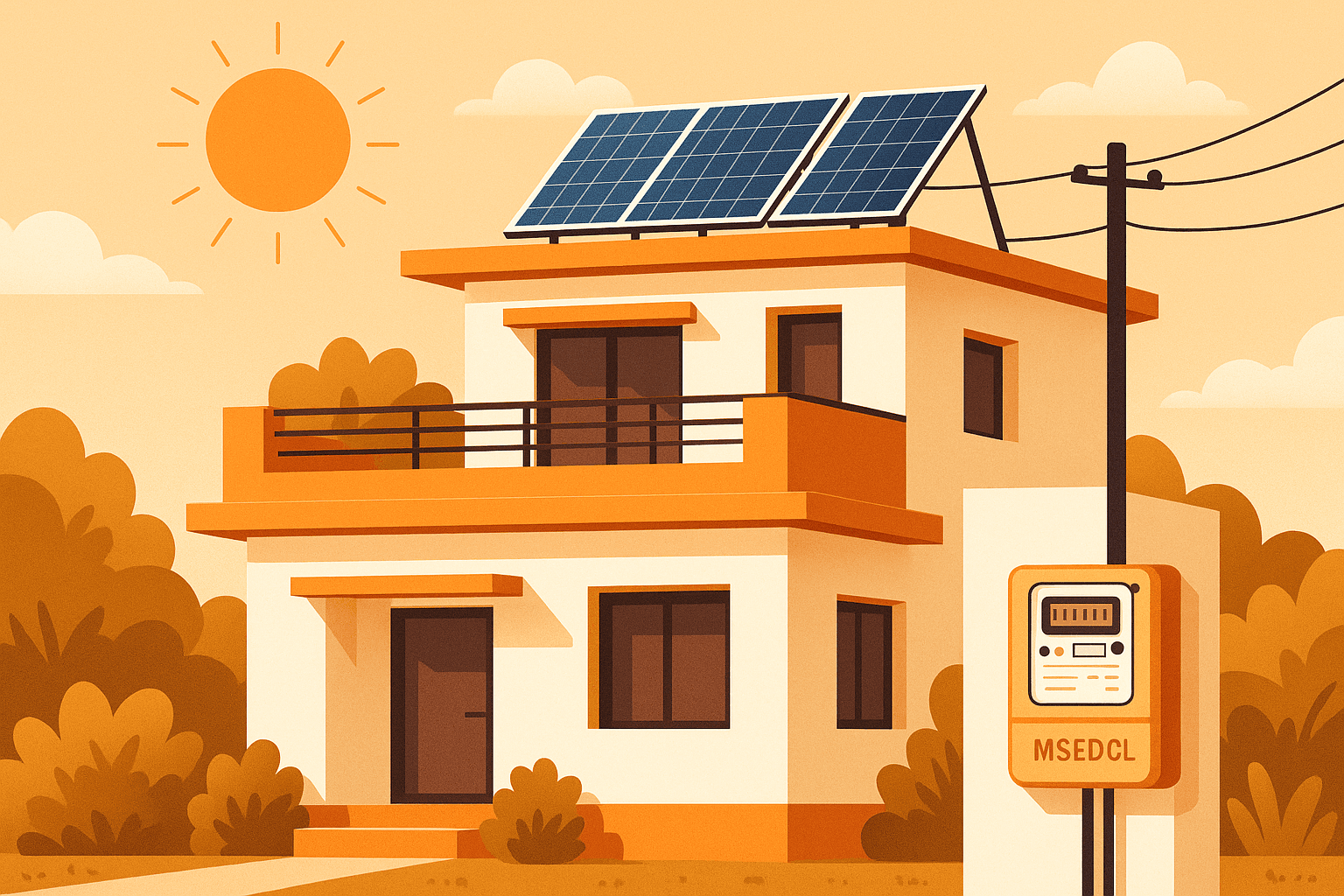
How Net Metering Works in Maharashtra (2026): Sell Solar Electricity to MSEDCL
Every month, lakhs of homes across Maharashtra watch their MSEDCL electricity bills climb higher. The average Dhule household consuming 350-400 units pays anywhere between Rs. 3,500 and Rs. 5,000 per month. But what if your rooftop could turn that bill almost to zero — and what if the electricity company actually paid you for the power you didn't use?
That is exactly what net metering does. It is the mechanism that allows you to install solar panels on your roof, use the electricity you generate during the day, and sell whatever you don't consume back to MSEDCL's grid. Your electricity meter literally runs backward when your panels produce more than your home consumes.
In this guide, we break down everything you need to know about net metering in Maharashtra for 2026 — the MERC regulations, the MSEDCL billing process, tariff rates, how to apply, what documents you need, and a real month-by-month example of what happens to a Dhule homeowner's bill after going solar.
What Is Net Metering? A Simple Analogy
Think of net metering like a bank account for electricity.
During the daytime, your solar panels produce electricity. Your home uses some of it — running fans, lights, refrigerator, TV. But between 10 AM and 4 PM, when the sun is at its strongest and your family might be at work or school, your panels often produce more electricity than your home needs.
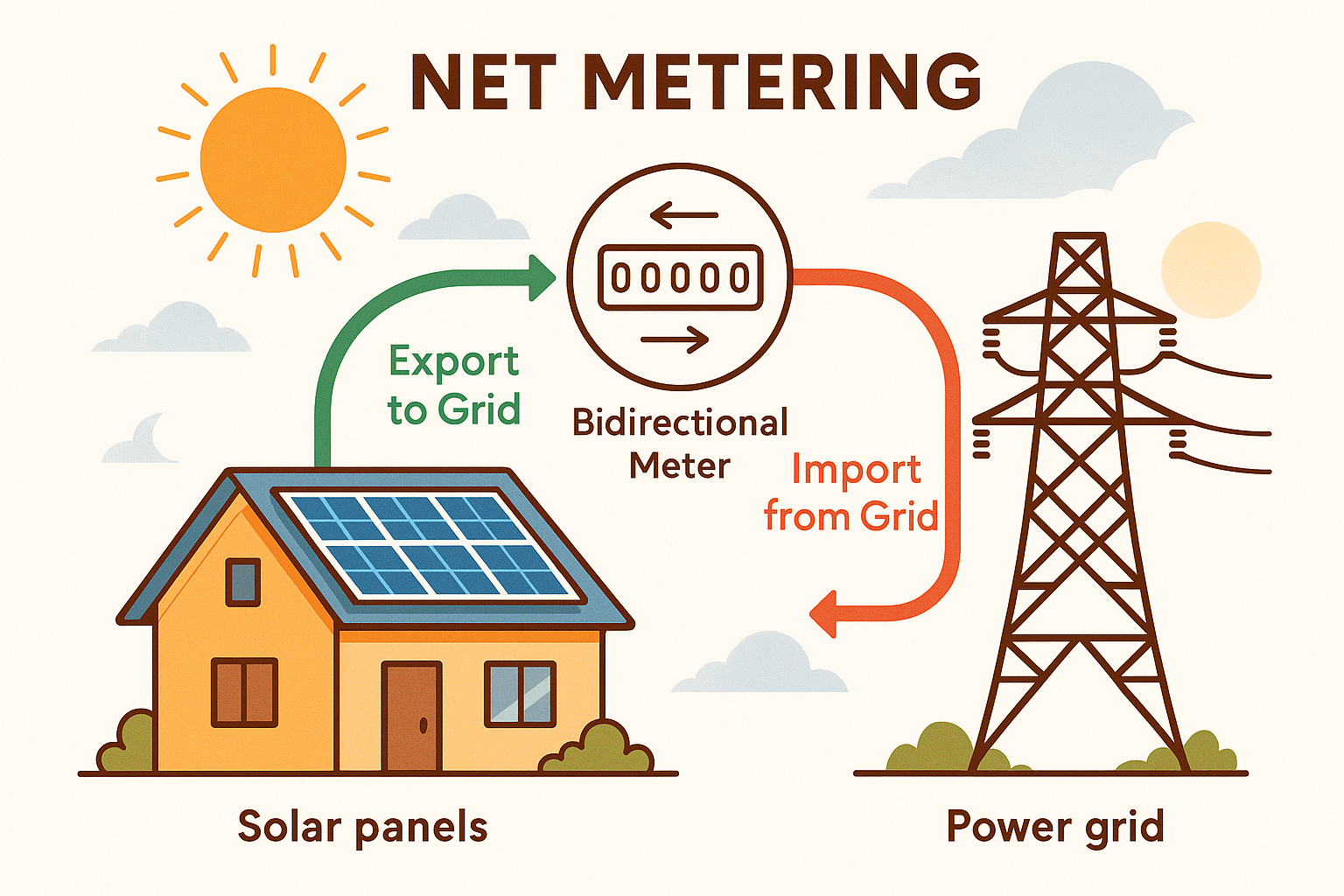
Without net metering, that surplus energy would simply be wasted. With net metering, the surplus flows out through your meter into MSEDCL's grid — essentially "depositing" units of electricity into your account. In the evening, when the sun goes down and your panels stop producing, you draw electricity from the grid as usual — "withdrawing" from your account.
At the end of the month, MSEDCL checks your balance:
- If you consumed more than you produced (the usual case), you pay only for the net difference. If you consumed 400 units from the grid but exported 280 units back, you pay for just 120 units.
- If you produced more than you consumed, the surplus credits carry forward to the next month — like a rollover balance in a mobile plan.
- At the end of the financial year (March 31), any remaining surplus credits are settled at the MERC-approved rate of Rs. 2.82/kWh for FY 2025-26.
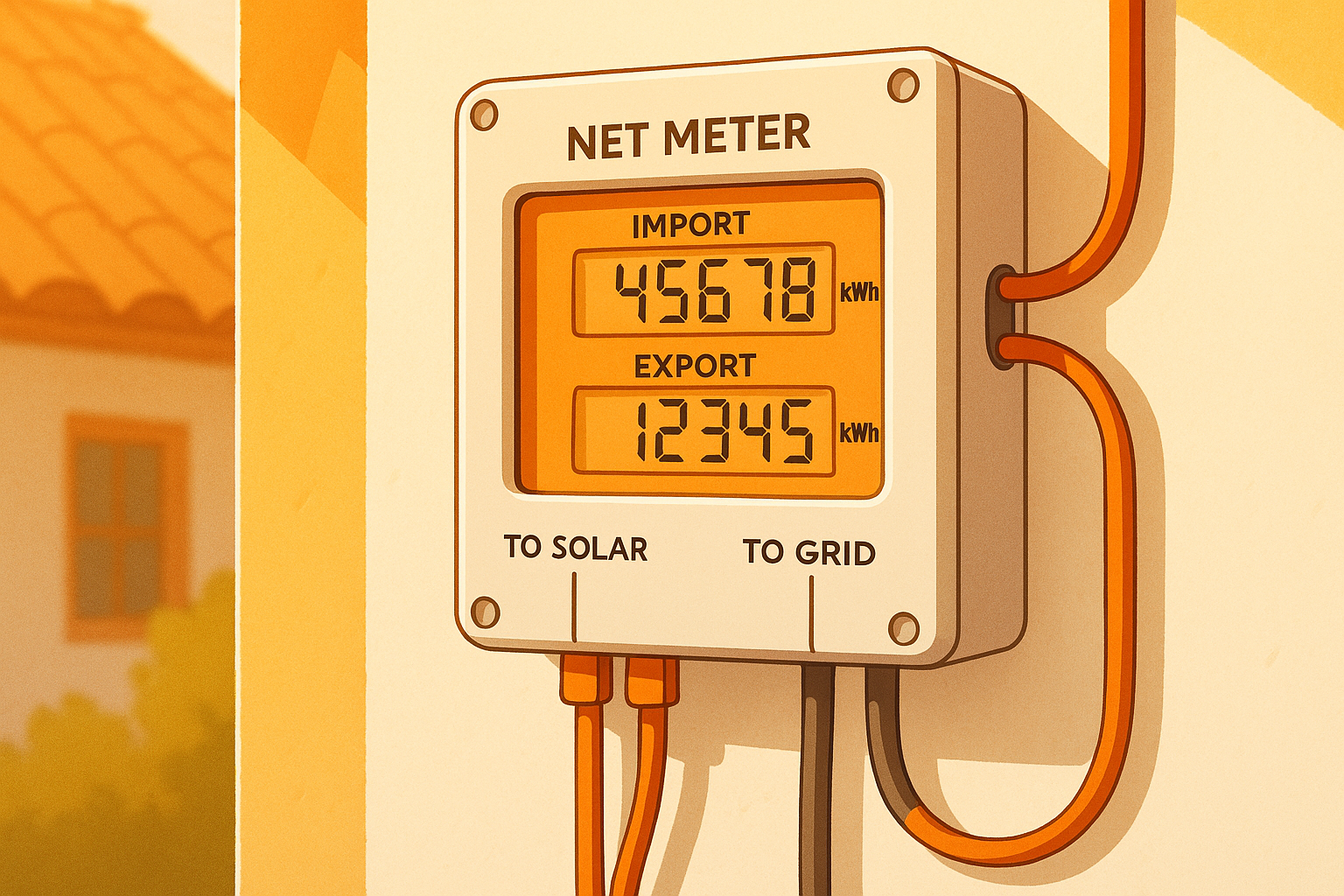
The key hardware that makes this work is a bidirectional meter (also called a net meter or smart meter), which replaces your old one-way meter. It tracks electricity flowing in both directions — imports from the grid and exports to the grid.
How Net Metering Works in Maharashtra: The MSEDCL Process
Net metering in Maharashtra is governed by two authorities:
- MERC (Maharashtra Electricity Regulatory Commission) — sets the regulations, tariff rates, and dispute resolution framework.
- MSEDCL (Maharashtra State Electricity Distribution Company Limited, also called Mahavitaran) — the distribution company that processes applications, installs meters, and handles billing for most of Maharashtra outside Mumbai.
Here is how the process works once your solar system is installed:
Monthly Billing Cycle
Every month, MSEDCL reads your bidirectional meter and records two figures:
- Import units — electricity drawn from the grid (mostly evenings and nights)
- Export units — surplus electricity sent to the grid (mostly daytime)
Your bill is calculated on the net consumption (import minus export). If you imported 350 units and exported 220 units, you are billed for only 130 units — at the applicable MSEDCL slab rate.
Credit Carry Forward
If your export exceeds your import in any month (common in sunny months like March-May), the surplus is carried forward as energy credits to the next billing cycle. You are not paid cash each month; instead, the credits accumulate and offset future bills.
Annual Settlement
At the end of the financial year (April 1 to March 31), any remaining surplus credits that were not consumed are settled. MERC has set the generic rooftop solar tariff at Rs. 2.82/kWh for FY 2025-26. This means if you have 200 surplus units at year-end, MSEDCL credits Rs. 564 to your account.
Residential Consumers and Time-of-Day (ToD) Meters
Under the latest MERC Multi-Year Tariff (MYT) order for FY 2025-26 to FY 2029-30, residential consumers with rooftop solar will continue to benefit from net metering upon installation of a ToD/smart meter. Importantly, there is no restriction on adjustment of banked energy during any hours of the day for residential consumers — meaning your daytime solar credits fully offset your evening consumption at the same rate.
Net Metering vs Gross Metering vs Net Billing
Maharashtra offers multiple metering options for solar consumers. Understanding the differences helps you choose wisely.
| Feature | Net Metering | Net Billing | Gross Metering |
|---|---|---|---|
| How it works | You use solar power first; only surplus goes to grid | Similar to net metering, but export valued at lower rate | All generated power goes to grid; you buy all power separately |
| Export rate | Same as your retail tariff (Rs. 4-14/unit depending on slab) | Lower feed-in tariff (Rs. 2.82/unit in FY 2025-26) | Fixed feed-in tariff (Rs. 2.82/unit) |
| Self-consumption | Yes — you use your own solar power directly | Yes — you use your own solar power directly | No — everything goes to grid first |
| Billing | Pay for net units (import minus export) | Separate accounting for import and export | Two separate meters, two separate bills |
| Best for | Residential homes and small businesses | Situations where export value might change | Large-scale power plants and commercial projects |
| Savings potential | Highest (70-90% bill reduction) | Moderate (50-70% bill reduction) | Lowest (30-50% bill reduction) |
| Minimum capacity | 1 kW | 1 kW | Typically 10 kW+ |
Our recommendation for Dhule homeowners: Net metering is the clear winner. When you export a unit under net metering, it offsets a unit you would have purchased at Rs. 9-14 per unit (depending on your consumption slab). Under gross metering, that same unit is purchased from you at only Rs. 2.82. The math is simple — net metering saves you 3-5 times more money.
How Your Monthly Bill Changes After Solar: A Month-by-Month Example
Let's trace what happens to a typical Dhule household that installs a 3 kW rooftop solar system with net metering. Before solar, the family consumes about 380 units/month and pays approximately Rs. 4,200/month.
After installing solar, the 3 kW system generates approximately 360-420 units/month (Dhule receives about 5.0-5.2 peak sun hours daily). Here is a realistic month-by-month picture:
| Month | Grid Import (units) | Solar Export (units) | Net Units Billed | Approx. Bill (Rs.) | Credits Carried Forward |
|---|---|---|---|---|---|
| April | 160 | 260 | 0 | 100 (fixed charges only) | 100 units |
| May | 140 | 290 | 0 | 100 | 250 units |
| June | 180 | 210 | 0 | 100 | 280 units |
| July | 200 | 180 | 20 | 190 | 260 units (used 20 from bank) |
| August | 210 | 170 | 40 | 480 | 220 units |
| September | 190 | 200 | 0 | 100 | 230 units |
| October | 170 | 240 | 0 | 100 | 300 units |
| November | 160 | 220 | 0 | 100 | 360 units |
| December | 170 | 200 | 0 | 100 | 390 units |
| January | 180 | 210 | 0 | 100 | 420 units |
| February | 160 | 240 | 0 | 100 | 500 units |
| March | 150 | 270 | 0 | 100 | Settlement: 620 units |
Annual summary:
- Before solar: 380 units x 12 months = 4,560 units consumed. Annual bill: ~Rs. 50,400
- After solar: Net billed units for the year: ~60 units. Annual bill: ~Rs. 1,670 (mostly fixed charges) + Rs. 1,749 settlement credit (620 units x Rs. 2.82)
- Effective annual savings: Rs. 48,700+ (over 96% reduction)
Note: Fixed charges (approximately Rs. 100/month for residential connections) still apply regardless of net metering. Actual generation varies by season, weather, panel orientation, and shading.
MSEDCL Tariff Rates: What You Are Offsetting
Understanding the tariff slabs tells you exactly how much each solar unit saves you. The higher your consumption, the more expensive each additional unit — and the more valuable your solar generation becomes.
Residential (LT) Tariff — FY 2025-26
| Consumption Slab | Energy Charge (Rs./kWh) |
|---|---|
| 0-100 units | 4.43 |
| 101-300 units | 9.64 |
| 301-500 units | 12.83 |
| Above 500 units | 14.33 |
Source: MERC MYT Order for FY 2025-26 (Case No. 217 of 2024). Tariff reduced by 10% compared to FY 2024-25.
Why This Matters for Solar
If your household consumes 400 units, you are paying:
- First 100 units at Rs. 4.43 = Rs. 443
- Next 200 units at Rs. 9.64 = Rs. 1,928
- Last 100 units at Rs. 12.83 = Rs. 1,283
- Total energy charge: Rs. 3,654 (plus fixed charges, electricity duty at 16%, and fuel adjustment)
When solar brings your net consumption down to just 100 units, you pay only Rs. 443 for energy — a direct saving of Rs. 3,211 on energy charges alone, every month.
The key insight: solar generation offsets your most expensive units first (the top slabs), making every exported unit worth Rs. 9-14 — not the Rs. 2.82 you would get from annual settlement.
Other Consumer Categories
| Consumer Category | Typical Rate Range (Rs./kWh) | Net Metering Available? |
|---|---|---|
| Commercial (LT) | 9.50 - 14.80 | Yes |
| Industrial (LT) | 8.20 - 12.50 | Yes |
| Agricultural | 1.50 - 4.00 (subsidized) | Yes |
| Public Water Works | 5.50 - 8.50 | Yes |
Maximum System Size and MERC Regulations
Before sizing your solar system, you need to know these regulatory limits:
Size Limits
| Parameter | Limit |
|---|---|
| Minimum system size | 1 kW |
| Maximum system size (net metering) | 500 kW |
| Maximum relative to sanctioned load | 100% of sanctioned load |
| Distribution transformer limit | Cumulative solar capacity cannot exceed 40% of local distribution transformer capacity |
Practical example: If your MSEDCL connection has a 5 kW sanctioned load, your solar system can be up to 5 kW. Most Dhule homes have a 3-5 kW sanctioned load, making a 3 kW system the sweet spot — it matches typical consumption and maximizes the PM Surya Ghar subsidy.
PM Surya Ghar Muft Bijli Yojana (Central Subsidy)
The central government's flagship rooftop solar scheme provides substantial subsidies:
| System Size | Subsidy Amount |
|---|---|
| Up to 2 kW | 60% of benchmark cost (~Rs. 30,000/kW) |
| 2 kW to 3 kW | 40% of benchmark cost for the incremental capacity |
| 3 kW to 10 kW | Rs. 78,000 (fixed cap) |
For a 3 kW system: Total subsidy of approximately Rs. 78,000, bringing your out-of-pocket cost to around Rs. 50,000-70,000 (from a total cost of Rs. 1.3-1.5 lakh).
Maharashtra SMART Solar Scheme (State Subsidy)
Announced in October 2025, the Swayampurna Maharashtra Residential Rooftop Solar (SMART) scheme provides an additional state-level subsidy. Combined with the PM Surya Ghar scheme, eligible households can receive up to 95% subsidy on their rooftop solar installation — making a 3 kW system available for as low as Rs. 7,000-10,000 in some cases.
Step-by-Step: How to Apply for Net Metering in Maharashtra
Step 1: Choose a Certified Solar Installer
Select an installer empaneled with MNRE (Ministry of New and Renewable Energy) or MEDA (Maharashtra Energy Development Agency). This is mandatory — MSEDCL will not approve net metering for systems installed by uncertified vendors.
Step 2: System Design and Installation
Your installer designs the system based on your rooftop area, sanctioned load, monthly consumption, and budget. After you approve the design, physical installation typically takes 2-3 days for residential systems.
Step 3: Submit Net Metering Application
Apply online through the MSEDCL Solar PV Application portal at css.mahadiscom.in/solar.aspx or submit a physical application at your local MSEDCL office.
You will need to upload all required documents (listed below) and pay the applicable processing fee.
Step 4: Technical Feasibility Study
MSEDCL conducts a feasibility study within 7-10 working days to confirm that your local grid infrastructure can handle the solar system's output. This includes checking the distribution transformer capacity (40% rule).
Step 5: System Inspection
An MSEDCL engineer visits your site to verify that the solar system is properly installed, wiring meets safety standards, and the system capacity matches your application. This happens within 10-15 working days of feasibility approval.
Step 6: Bidirectional Meter Installation
After passing inspection, MSEDCL installs a bidirectional net meter (replacing your old meter) within 10 working days. The meter records both import and export readings.
Meter costs:
- Single-phase bidirectional meter: Rs. 15,000 - Rs. 25,000 (including installation)
- Three-phase bidirectional meter: Rs. 20,000 - Rs. 30,000 (including installation)
Approved meter brands in Maharashtra include L&T and Secure Meters.
Step 7: Sign the Power Purchase Agreement (PPA)
You sign a PPA with MSEDCL that formalizes the net metering arrangement — billing terms, credit carry-forward rules, settlement methodology, and your obligations as a solar prosumer.
Step 8: Commissioning and Go-Live
Your system is officially commissioned. From this point, every unit your panels produce starts earning you savings. Credits begin appearing on your next MSEDCL bill.
Total timeline: 30-60 days from application to commissioning.
Documents Required for Net Metering Application
Keep these documents ready before starting the application:
- Net metering application form (downloadable from MSEDCL portal)
- Latest MSEDCL electricity bill (showing consumer number and sanctioned load)
- Aadhaar Card of the property owner
- PAN Card of the property owner
- Property ownership proof (title deed, property tax receipt, or society letter)
- Passport-size photograph
- Solar system technical specifications (panel make, inverter make, total capacity)
- Single-line diagram (SLD) of the solar installation (your installer prepares this)
- Installation certificate from the MNRE/MEDA-certified installer
- Lease agreement (if the property is rented — requires owner's NOC)
Pro tip: Your solar installer typically handles the entire documentation and application process as part of their service. At AceSolarTech, we manage every step — from application filing to meter installation coordination.
Real Example: A Dhule Homeowner's Before vs After Bill
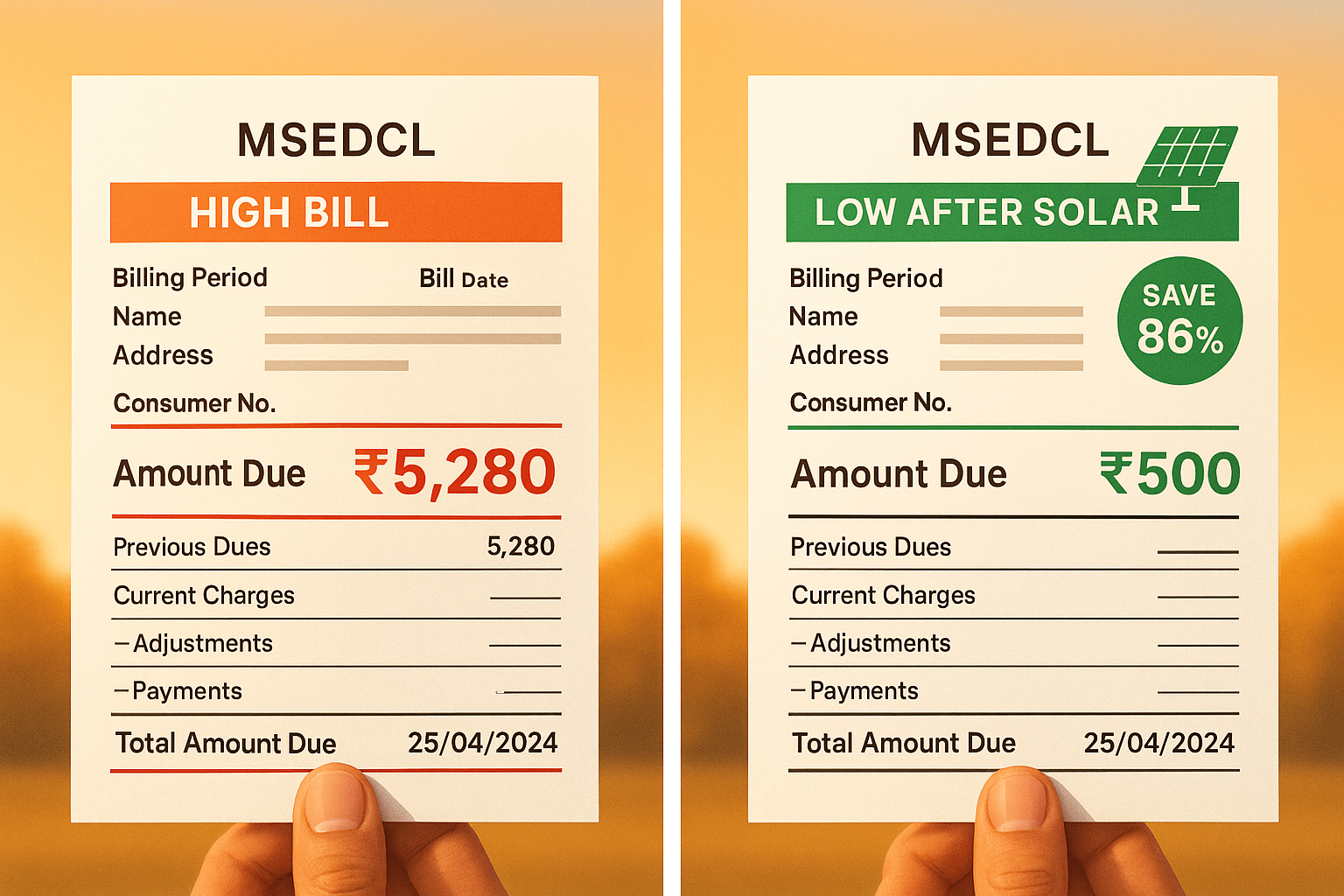
Let's look at Rajesh Patil, a homeowner in Dhule with a family of five. Here is his real bill breakdown:
Before Solar (Monthly)
| Bill Component | Amount (Rs.) |
|---|---|
| Energy charge (380 units across slabs) | 3,654 |
| Fixed charge (5 kW load) | 115 |
| Electricity duty (16%) | 585 |
| Fuel adjustment charge | 280 |
| Other charges | 65 |
| Total monthly bill | 4,699 |
| Annual electricity cost | ~56,400 |
After 3 kW Solar System with Net Metering (Monthly Average)
| Bill Component | Amount (Rs.) |
|---|---|
| Net consumption (avg. 80 units after solar offset) | 355 |
| Fixed charge (5 kW load) | 115 |
| Electricity duty (16%) | 57 |
| Fuel adjustment charge | 60 |
| Other charges | 65 |
| Total monthly bill | ~652 |
| Annual electricity cost | ~7,800 |
Savings Summary
| Metric | Value |
|---|---|
| Annual savings | Rs. 48,600 |
| Monthly savings | Rs. 4,050 |
| Bill reduction | 86% |
| System cost (after PM Surya Ghar subsidy) | Rs. 65,000 |
| Payback period | 16 months |
| 25-year lifetime savings | Rs. 12+ lakh |
Rajesh's system generates about 370 units/month on average. During peak summer months (March-May), his export exceeds import, and credits accumulate. During the monsoon (July-August), production dips slightly, but his annual average comfortably covers his consumption.
Common Mistakes and How to Avoid Them
1. Oversizing the System Beyond Sanctioned Load
Mistake: Installing a 5 kW system on a 3 kW sanctioned load. Consequence: MSEDCL will reject the net metering application. Solution: Match your system size to your sanctioned load. If you need more capacity, apply for a load enhancement first.
2. Using a Non-Certified Installer
Mistake: Hiring a local electrician to install panels to save money. Consequence: MSEDCL will not approve net metering. You lose subsidy eligibility and warranty coverage. Solution: Always use an MNRE or MEDA-empaneled installer.
3. Ignoring Shading Analysis
Mistake: Installing panels where a water tank, tree, or neighboring building casts shadows. Consequence: Even 10% shading on one panel can reduce the entire string's output by 30-40%. Solution: Insist on a proper shading analysis before installation. Your installer should check shadow patterns across all seasons.
4. Not Applying for Subsidy Before Installation
Mistake: Installing first, then trying to claim PM Surya Ghar subsidy. Consequence: The subsidy process requires registration on the national portal before installation. Solution: Register at pmsuryaghar.gov.in first, get DISCOM approval, then proceed with installation.
5. Forgetting About the Distribution Transformer Limit
Mistake: Assuming you can install any size system as long as it matches your sanctioned load. Consequence: If the cumulative solar capacity in your area already exceeds 40% of the distribution transformer capacity, MSEDCL will reject new applications for that transformer. Solution: Check with MSEDCL or your installer about local transformer capacity before investing.
6. Not Monitoring Monthly Generation
Mistake: Installing the system and forgetting about it. Consequence: Panel degradation, inverter faults, or connection issues can go unnoticed for months, costing you thousands in lost generation. Solution: Check your bidirectional meter readings monthly. Most modern inverters also have mobile apps that show daily generation data.
Frequently Asked Questions (FAQ)
1. Can I completely eliminate my MSEDCL bill with net metering?
Not entirely. Fixed charges (approximately Rs. 100-115/month for residential connections), electricity duty, and minimum billing charges still apply regardless of net metering. However, you can reduce your energy charges by 85-100%, bringing your total bill down to Rs. 500-800/month from Rs. 4,000-5,000.
2. What happens to surplus credits at the end of the financial year?
Any surplus energy credits remaining at the end of the financial year (March 31) are settled at the MERC-approved generic rooftop solar tariff rate, which is Rs. 2.82/kWh for FY 2025-26. This amount is credited to your MSEDCL account.
3. Does net metering work during power cuts?
No. For safety reasons, grid-connected solar systems with net metering automatically shut down during power cuts (this is called anti-islanding protection). This prevents your system from feeding electricity into the grid while linemen may be working on repairs. If you need power during outages, you need a hybrid solar system with battery backup.
4. Can I get net metering for a rented property?
Yes, but you need a No Objection Certificate (NOC) from the property owner along with the lease agreement. The MSEDCL consumer number must be in the applicant's name or the owner must authorize the application.
5. How long does the net metering approval process take?
The complete process — from application submission to meter installation and commissioning — takes approximately 30-60 days. MSEDCL is mandated to complete testing and commissioning within 10 working days of receiving the request, and meter installation within 10 working days thereafter.
6. Can I avail net metering and open access simultaneously?
Yes. In a landmark ruling in 2025, MERC directed MSEDCL to allow net metering for rooftop solar consumers who are also availing open access. This is particularly relevant for commercial and industrial consumers who source partial power through open access.
7. What is the difference between net metering and virtual net metering?
Standard net metering applies to a single consumer with a solar system on their premises. Virtual Net Metering (VNM) allows multiple consumers — such as residents of a housing society — to share power from a single, larger solar plant. Each participant receives bill credits based on their predetermined share of the generation.
8. Is there a limit on how many years I can use net metering?
The net metering agreement (PPA) is typically valid for 25 years, aligned with the expected lifespan of solar panels. The billing terms may be revised periodically in line with MERC tariff orders.
9. Do I need to pay for the bidirectional meter?
Yes. The bidirectional meter cost ranges from Rs. 15,000-25,000 for single-phase and Rs. 20,000-30,000 for three-phase connections. This is usually included in the overall system cost quoted by your installer. Approved brands in Maharashtra are L&T and Secure Meters.
10. What if MSEDCL rejects my net metering application?
Common reasons for rejection include exceeding sanctioned load limits, local distribution transformer capacity being exhausted, incomplete documentation, or using a non-certified installer. If you believe the rejection is unjustified, you can appeal to MERC's grievance redressal forum. Recent MERC rulings have generally been pro-consumer, directing MSEDCL to allow net metering in disputed cases.
Ready to Start Saving? AceSolarTech Handles Everything
Navigating MSEDCL's net metering process, subsidy applications, and documentation can feel overwhelming. That is exactly why AceSolarTech exists.
We handle the entire process for Dhule and Maharashtra homeowners:
- Free site survey and shading analysis
- System design matched to your sanctioned load and consumption
- MNRE-certified installation with Tier-1 panels
- Complete net metering application filing on MSEDCL portal
- PM Surya Ghar and Maharashtra SMART subsidy processing
- Document preparation and submission
- Coordination with MSEDCL for inspection and meter installation
- PPA signing assistance
- Post-installation monitoring support
Our promise: You sign one agreement with us. We deliver a working, net-metered solar system with all approvals in place. No running between MSEDCL offices. No paperwork headaches.
Get Your Free Solar Assessment
Tell us your monthly MSEDCL bill amount and we will calculate your exact savings, system size, subsidy eligibility, and payback period — in under 2 minutes.
WhatsApp us now: Chat with AceSolarTech on WhatsApp
Or visit our Solar Savings Calculator to estimate your savings right now.
Disclaimer: Tariff rates, subsidy amounts, and regulatory details mentioned in this article are based on MERC and MSEDCL information available as of February 2026. Rates are subject to revision. Always verify current rates with your local MSEDCL office or an authorized solar installer. AceSolarTech is not affiliated with MSEDCL or MERC.