

Solar Panel Maintenance Guide: 15 Expert Tips to Maximize Your 25-Year System Lifespan
You invested lakhs in a rooftop solar system. It is quietly generating clean electricity, cutting your MSEDCL bill, and paying for itself month after month. But here is the uncomfortable truth: a neglected solar system loses 1-2% efficiency every year. Over a 25-year lifespan, that compounds into thousands of units of lost electricity and tens of thousands of rupees left on the table.
The good news? Solar panels are among the lowest-maintenance investments you will ever make. With a handful of simple habits and a seasonal maintenance rhythm tuned to Maharashtra's climate, your system will perform at peak efficiency for its entire 25-year warranty period and beyond.
This guide covers everything: from cleaning techniques that work on Dhule's dusty rooftops to monsoon-proofing your wiring, from reading your inverter's error codes to knowing exactly when to call a professional. Whether you installed last month or five years ago, these 15 expert tips will protect your investment and maximize your returns.
Understanding Solar Panel Degradation
Before diving into the tips, it helps to understand why panels lose efficiency over time.
Light-Induced Degradation (LID) causes a one-time 1-3% efficiency loss during the first year of operation, as boron-oxygen defects in the silicon cells stabilize under sunlight. This is normal and already accounted for in manufacturer warranties.
Annual degradation after the first year is typically 0.5-0.7% per year under ideal conditions. However, research on 36 operational solar projects in India found an average annual degradation of 1.47% — roughly double the global average — driven primarily by heat stress in hot climates like Maharashtra.
Potential-Induced Degradation (PID) appears after 5-10 years in high-voltage, high-humidity environments and can cause significant power loss if undetected.
Hot spots develop when one cell is shaded or damaged while others produce normally. The shaded cell becomes a resistive load, overheating and potentially damaging the panel permanently.
The takeaway: maintenance is not optional in India's climate. It is the difference between losing 0.5% or 1.5% per year — and over 25 years, that gap represents a massive difference in total energy production.
Regular Cleaning (Tips 1-4)
Tip 1: Clean Your Panels Every 3-4 Weeks in Dry Season
In Maharashtra's dry months (October through May), dust, pollen, and pollution settle on panels rapidly. Studies show that dust accumulation alone can reduce solar panel efficiency by 15-25%. In extreme cases, dirty panels produce only 2-3 units per day compared to 5-7 units when clean.
Recommended frequency:
- Dry season (Oct-May): Every 3-4 weeks
- Monsoon season (Jun-Sep): Rain handles light cleaning; inspect monthly
- Urban/industrial areas: Every 2-3 weeks
- Near construction sites: Weekly inspection
For a typical 3-5 kW rooftop system in Dhule, a 15-minute cleaning session every few weeks is all it takes to maintain peak output.
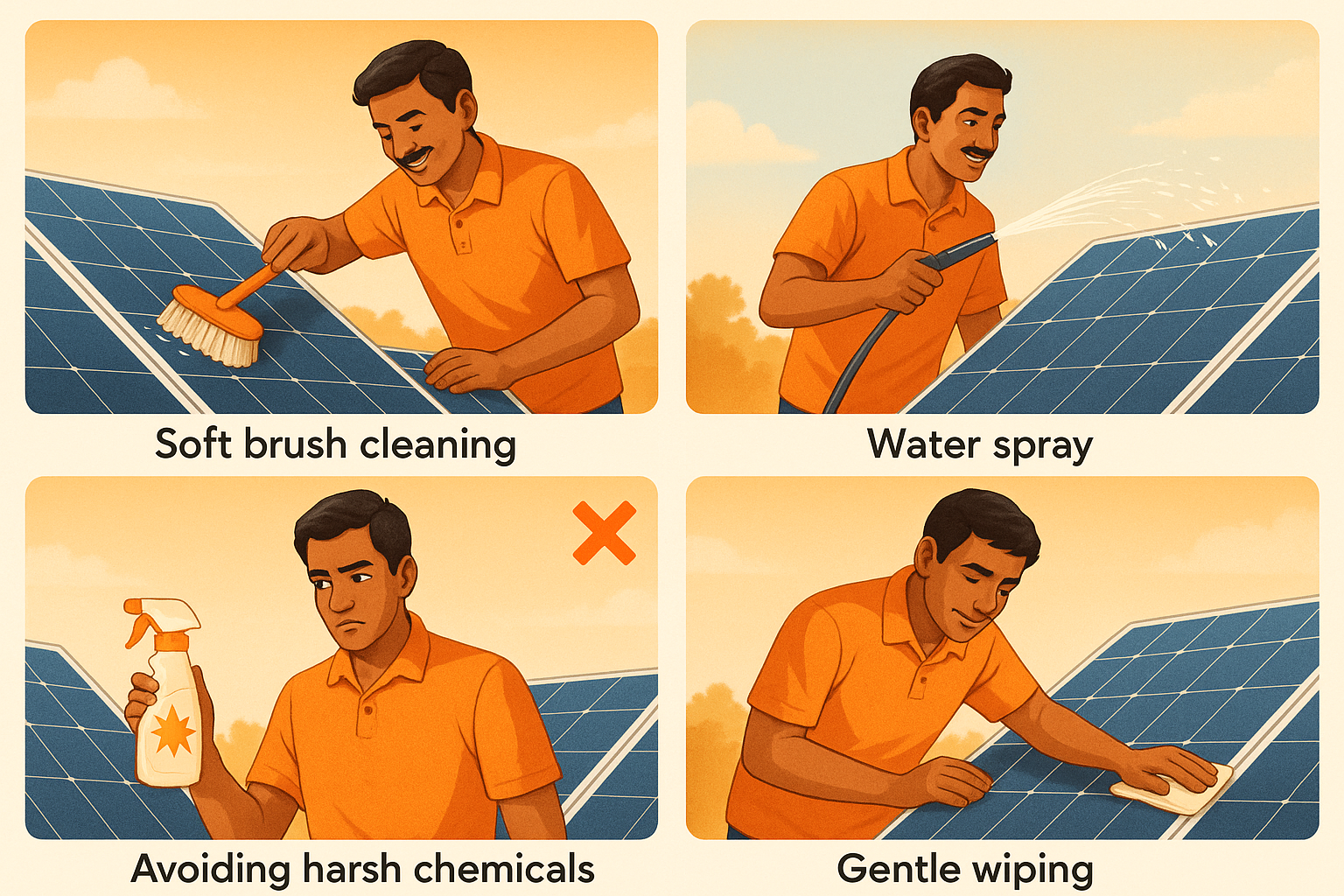
Tip 2: Use the Right Cleaning Method
The wrong cleaning approach can scratch the anti-reflective coating on your panels, causing permanent damage. Follow these guidelines:
Cleaning DOs:
- Use plain water or a mild, non-abrasive soap solution
- Use a soft sponge, microfiber cloth, or a soft-bristle brush with a long handle
- Clean early morning (6-8 AM) or late evening when panels are cool
- Use a standard garden hose with gentle water pressure
- Rinse from top to bottom so dirty water flows off
- Dry with a soft squeegee to prevent water spots
Cleaning DON'Ts:
- Never use a pressure washer (damages cells and seals)
- Never use abrasive scrubbers, steel wool, or rough cloths
- Never clean in the afternoon sun (thermal shock from cold water on hot glass can crack panels)
- Never use harsh chemicals, detergents, or solvents
- Never walk on the panels
- Never spray water on the electrical connections or junction boxes
Tip 3: Pay Attention to Water Quality
Hard water leaves mineral deposits on the glass surface that are difficult to remove and reduce light transmission over time. In many parts of Maharashtra, bore well water has high TDS (Total Dissolved Solids).
Best practices:
- Use municipal (tap) water where possible
- If only hard water is available, use a final rinse with RO-filtered or distilled water
- Remove mineral deposits immediately with a vinegar-water solution (1:4 ratio) and a soft cloth
- Consider a water softener attachment for your hose if mineral buildup is a recurring issue
Tip 4: Consider Automated Cleaning for Larger Systems
For systems above 5 kW or commercial installations, manual cleaning becomes time-consuming and poses safety risks. Automated solutions include:
- Robotic panel cleaners: Devices that traverse the panel surface on a programmed schedule, using minimal water. Available from Indian brands like Taypro and SolarTech.
- Sprinkler systems: Timer-controlled sprinklers that rinse panels at dawn. Simple and cost-effective for larger arrays.
- Pneumatic (air jet) cleaning: Uses compressed air to dislodge dust without water. Particularly effective in water-scarce regions and prevents scratching entirely.
For most residential systems in Dhule (3-10 kW), manual cleaning remains the most practical and affordable option.
Seasonal Care for Maharashtra (Tips 5-7)
Maharashtra's climate throws three distinct challenges at your solar system: scorching summers, heavy monsoons, and mild but dusty winters. Here is your month-by-month game plan.
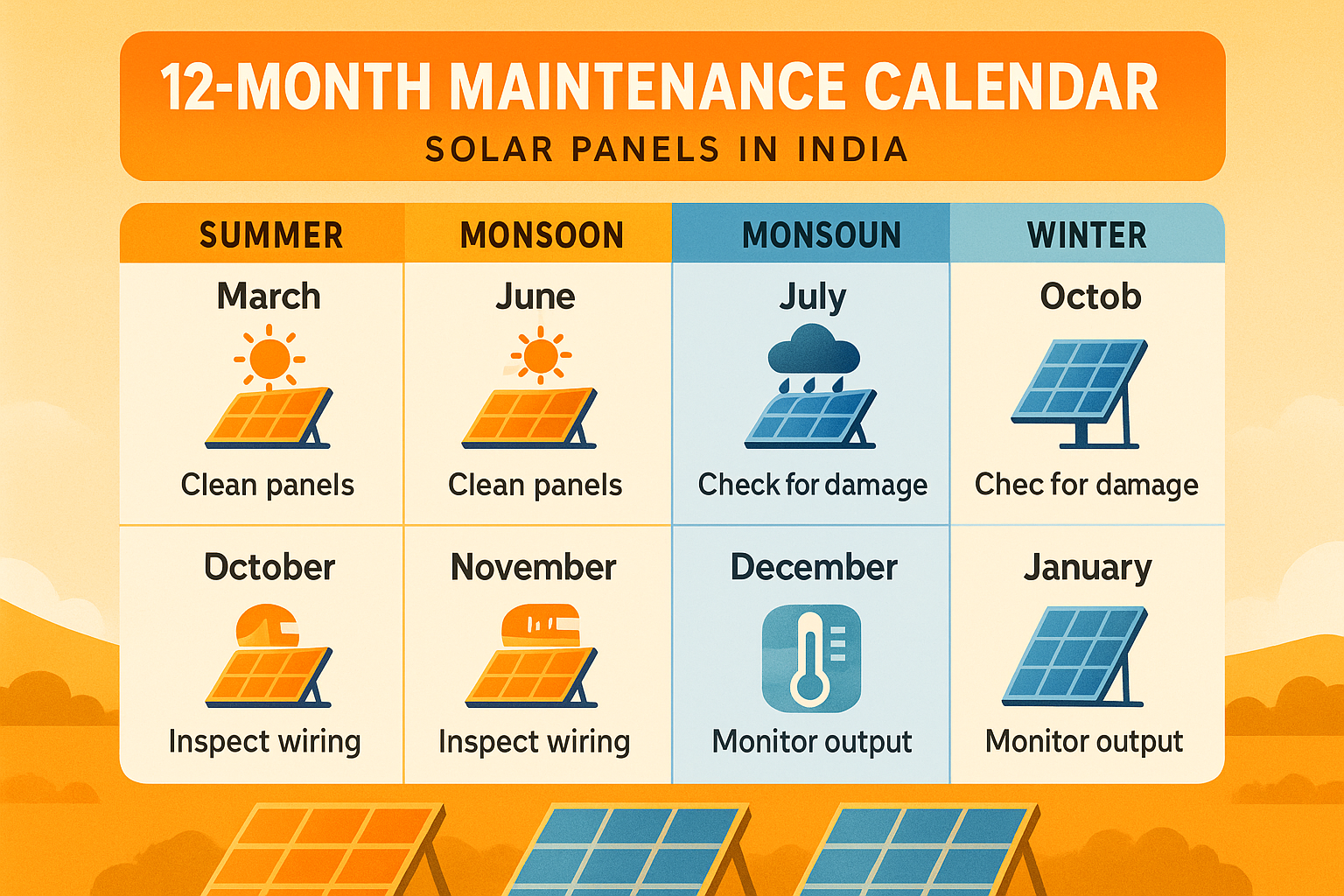
Maharashtra Solar Maintenance Calendar
| Month | Season | Key Tasks |
|---|---|---|
| January | Winter (mild) | Clean panels, check for dew/fog residue, inspect wiring |
| February | Late winter | Full system inspection, tighten mounting bolts |
| March | Pre-summer | Clean panels, check inverter ventilation, trim nearby trees |
| April | Summer onset | Ensure inverter is shaded, check for hot spots, clean panels |
| May | Peak summer (40-45 C) | Monitor inverter temperature, clean every 2-3 weeks, check battery ventilation |
| June | Monsoon onset | Pre-monsoon deep clean, waterproof all connections, clear drainage |
| July | Heavy monsoon | Monthly visual inspection, check for water pooling, inspect earthing |
| August | Monsoon peak | Monitor for leaks, check mounting bolts for rust, inspect cable insulation |
| September | Monsoon end | Post-monsoon deep clean, remove algae/moss buildup, full electrical check |
| October | Post-monsoon | Thorough cleaning, professional annual inspection, battery maintenance |
| November | Early winter | Clean panels, check all connections, trim vegetation |
| December | Winter | Monitor output (shorter days), clean panels, inspect structure |
Tip 5: Prepare Your System for Monsoon Season
Maharashtra receives 600-2,000 mm of rainfall during June-September. While rain naturally cleans your panels, the monsoon brings unique challenges:
Before monsoon (May-June):
- Do a thorough deep clean. Wet dirt hardens like cement once rain dries — remove all dust before the first rains.
- Inspect all cable connections. Ensure junction boxes are sealed and waterproof. Look for cracked cable insulation.
- Check that the mounting structure allows proper water drainage. Standing water accelerates corrosion and can seep into panel frames.
- Verify the earthing (grounding) system is intact. Monsoon lightning is a real threat.
- Clear leaves, branches, and debris from under and around the panels.
During monsoon:
- Do a visual inspection after every major storm. Look for physical damage from debris, hail, or falling branches.
- Check for water pooling on or under panels. This suggests drainage issues.
- Ensure inverter room/enclosure stays dry. Even a small leak can damage electronics.
- Monitor daily production through your app. A sudden drop during clear monsoon days could indicate a fault.
After monsoon (September-October):
- Do a full post-monsoon clean. Rain leaves mineral residue and bird droppings may have accumulated.
- Check all metal components for rust. Mounting brackets, cable clips, and structural bolts are particularly vulnerable.
- Look for algae or moss growth on or around panels — common after heavy rains.
- Schedule a professional inspection if production has dropped noticeably.
Tip 6: Manage Extreme Summer Heat (April-June)
Dhule regularly sees temperatures above 40 C, sometimes reaching 45 C. High temperatures directly reduce solar panel efficiency through a phenomenon called the temperature coefficient. For every degree Celsius above 25 C (the standard test temperature), your panels lose 0.3-0.45% efficiency.
At 45 C, that translates to a 6-9% efficiency loss compared to ideal conditions.
Heat management strategies:
- Ensure adequate airflow beneath panels. Maintain at least 10-15 cm gap between panels and roof surface. Blocked ventilation traps heat and increases cell temperature further.
- Keep inverters shaded. Direct sunlight on an inverter can push it into thermal shutdown. Install a shade cover or locate it on a north-facing wall.
- Water-cooling (for large systems): Spraying water on the back of panels during peak heat can reduce temperature by 10 C and boost output by 2-3%.
- Monitor for hot spots. Thermal imaging during summer can reveal damaged cells that overheat disproportionately. Hot spots are more dangerous in summer when ambient temperatures are already extreme.
- Battery care: If you have a battery system, ensure the battery room stays below 30 C. High temperatures drastically reduce battery lifespan.
Tip 7: Optimize for Winter and Haze (November-February)
Maharashtra winters are mild, but shorter days, morning fog, and agricultural burning haze (common in North Maharashtra) reduce solar output by 10-15%.
Winter optimization:
- Clean panels more frequently during haze season, as fine particulate matter settles on surfaces.
- Check for dew/condensation residue in early mornings. This can attract and hold dust.
- Adjust tilt angle if your mounting system allows it. A steeper tilt captures more low-angle winter sunlight.
- Trim any deciduous trees that have grown since installation. Bare branches still cast shadows.
Monitoring and Inspection (Tips 8-10)
Tip 8: Check Your Inverter Monthly
The inverter is the heart of your solar system — converting DC power from panels into AC power for your home. It is also the component most likely to fail before the panels themselves (typical inverter lifespan: 10-15 years vs. 25+ years for panels).
Monthly inverter checklist:
- Check status lights. Green means normal operation. Flashing red or amber indicates a fault.
- Note any error codes on the display. Record them and look up their meaning in the manual.
- Listen for unusual sounds — buzzing, clicking, or humming may indicate loose connections or failing components.
- Ensure ventilation openings are clear of dust, cobwebs, and debris.
- Verify the inverter enclosure is dry, especially during and after monsoon season.
- Check that firmware is up to date (for smart inverters with Wi-Fi connectivity).
When to worry: If your inverter shuts down during peak sun hours, shows frequent error codes, or produces a burning smell, disconnect and call a professional immediately.
Tip 9: Inspect Wiring and Connections Twice a Year
Loose or corroded connections are a leading cause of underperformance and a serious fire hazard. Inspect every six months — ideally before summer and before monsoon.
Visual wiring inspection (safe for homeowners):
- Look for discolored, melted, or frayed cable insulation
- Check that cable clips and ties are intact and cables are not hanging loose
- Look for signs of rodent or bird damage (chewed cables, nesting material)
- Ensure MC4 connectors between panels are firmly clicked together
- Check earthing wire connections for corrosion
Leave these to a professional:
- Tightening terminal connections inside the inverter or junction box
- Testing voltage and current with a multimeter
- Thermal imaging to detect hot connections
- Replacing damaged cables or connectors
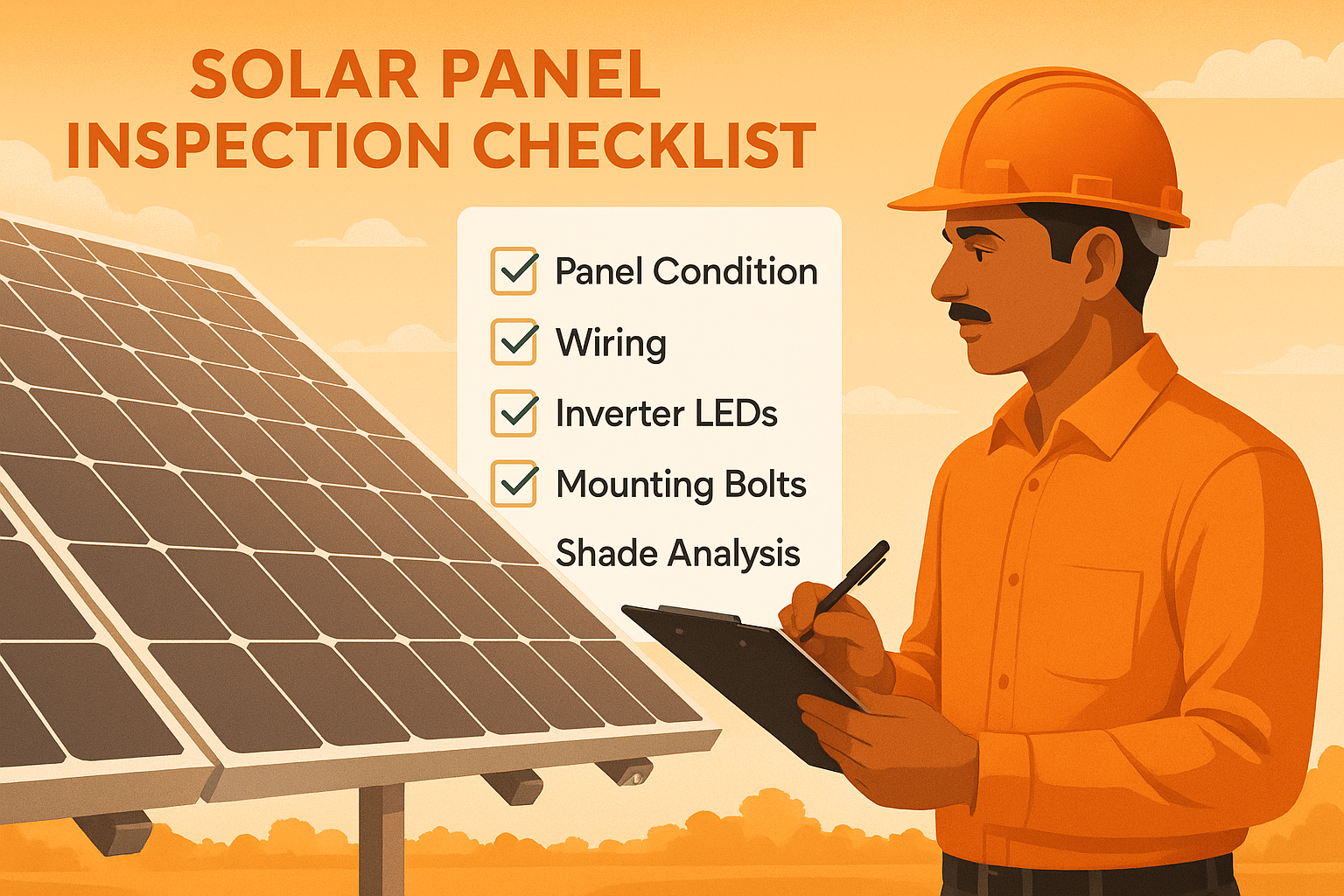
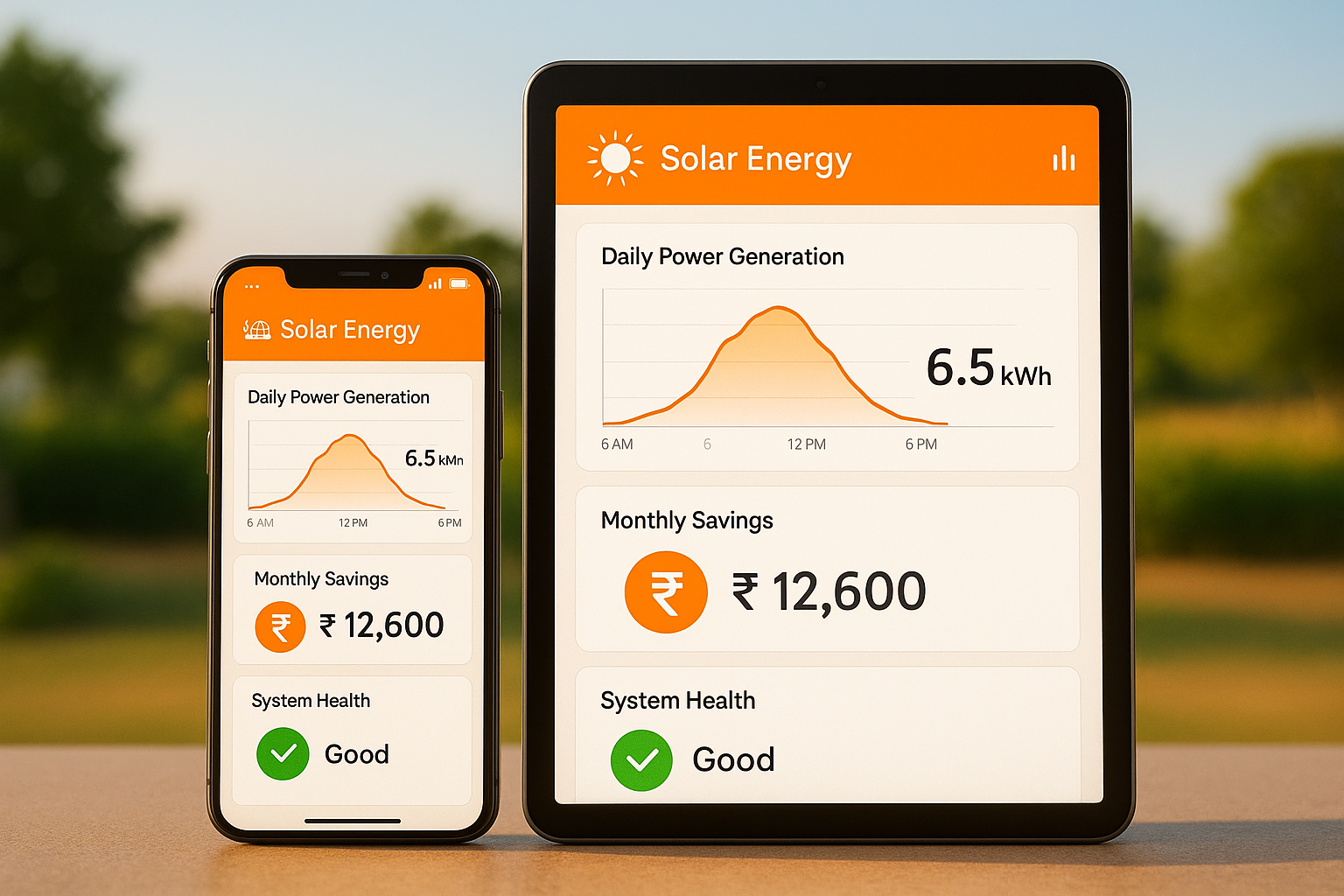
Tip 10: Use a Monitoring App to Track Daily Production
Modern solar inverters come with monitoring apps that show real-time and historical production data. This is your single most powerful maintenance tool — a sudden drop in production often reveals problems before they become visible.
Popular solar monitoring apps in India:
- Intello — India's top-rated solar monitoring app with 7-day instant analysis
- Freyr Energy Solar App — Comprehensive monitoring and complaint registration
- Tata Power Solar Plus — Real-time monitoring for Tata Power installations
- Brand-specific apps — Growatt, Solis, Goodwe, Fronius, and SMA all offer proprietary apps
What to monitor:
- Daily production (kWh): Compare to expected output for the season. A 10%+ drop on a clear day warrants investigation.
- Production curves: A healthy system shows a smooth bell curve peaking at midday. Flat spots or dips indicate shading or panel issues.
- Inverter efficiency: Should remain above 95%. A drop below 90% suggests inverter trouble.
- Alerts and error codes: Enable push notifications so you catch issues the same day they occur.
Pro tip: Keep a simple logbook (even a phone note) recording your monthly production totals. Over time, you will develop an intuitive sense for what is normal and what is not.
Professional Maintenance (Tips 11-12)
Tip 11: Schedule an Annual Professional Inspection
Even if everything looks fine, an annual professional inspection catches problems that are invisible to the untrained eye. A qualified technician brings tools you do not have — thermal cameras, IV curve tracers, insulation resistance testers — and the training to interpret the results.
Annual inspection should include:
- Thermal imaging of all panels to detect hot spots, micro-cracks, and failing cells
- IV curve testing to measure actual panel performance against rated specifications
- Insulation resistance testing on all DC wiring
- Torque check on all electrical connections
- Inspection of mounting structure integrity, bolt tightness, and corrosion
- Inverter performance analysis and firmware update
- Earthing system resistance test
- Cleaning of all components including inverter fans and vents
Expected cost: Annual Maintenance Contracts (AMC) in India range from Rs 2,000 to Rs 15,000 per year depending on system size and scope. For a typical 3-5 kW residential system, expect Rs 3,000-5,000 per year. This is less than 1% of your system cost — a small price for peace of mind and peak performance.
Tip 12: Know When to Call a Technician Immediately
Some issues cannot wait for the annual inspection. Call a professional right away if you notice:
- Sudden production drop of 20%+ on a clear, sunny day
- Inverter error codes that do not clear after a restart
- Burning smell from inverter, junction box, or any wiring
- Visible physical damage — cracked panels, broken glass, scorched marks
- Water ingress into inverter enclosure or junction boxes
- Tripped MCB (miniature circuit breaker) that trips again after resetting
- Buzzing or arcing sounds from electrical connections
- System completely stops producing power
Safety first: Never attempt electrical repairs yourself. Solar panels produce DC voltage even when disconnected from the inverter. Always engage a certified solar technician for any electrical work.
Long-term Protection (Tips 13-15)
Tip 13: Track Your Warranty and Keep Documentation
Your solar panels likely carry two warranties: a product warranty (10-15 years, covering manufacturing defects) and a performance warranty (25 years, guaranteeing minimum output — typically 80% of rated power at year 25).
Warranty best practices:
- Store all documents digitally: purchase invoice, warranty cards, installation certificate, and commissioning report.
- Register your warranty with the manufacturer within the required timeframe.
- Keep a record of all maintenance performed. Some warranties are voided by lack of scheduled maintenance.
- Photograph your system annually to document its condition.
- If filing a warranty claim, you will typically need: proof of purchase, installation photos, maintenance records, and evidence of the defect.
Insurance options in India: HDFC Ergo and ICICI Lombard offer solar panel warranty insurance that covers natural damage over 5-10 years. Some policies provide indemnity for up to 25 years. Premiums are modest and worth considering for high-value installations.
Important exclusion: Most insurance policies exclude damage caused by poor installation, lack of maintenance, or non-compliance with local regulations. Another reason to maintain a documented maintenance schedule.
Tip 14: Manage Tree Growth and Shade Proactively
A tree that was no issue at installation can become a major shade source in 3-5 years. Even one small leaf shadow on a panel can reduce that panel's output by half — and in series-connected systems, one shaded panel drags down the entire string.
Shade management strategy:
- Survey shade patterns twice a year (summer solstice in June and winter solstice in December), noting morning and afternoon shadow positions.
- Trim trees annually before they become a problem. Professional arborists can thin canopies to let more light through without removing the tree.
- Fast-growing species like neem, banyan, and tamarind (common in Maharashtra) may need yearly trimming. Slower-growing trees can go 3-5 years between maintenance.
- If new construction nearby casts shade, consult your installer about microinverters or power optimizers. These allow each panel to operate independently so one shaded panel does not affect the rest — boosting production by 15-25% in partially shaded conditions.
Tip 15: Maintain Your Battery System (Hybrid/Off-Grid)
If your solar system includes battery storage (increasingly common in areas with load-shedding), the batteries need separate maintenance attention.
Lead-acid battery maintenance:
- Check electrolyte (water) level monthly. In Maharashtra's heat, batteries lose water faster. Top up with distilled water only — never tap water.
- Keep terminals clean. Apply petroleum jelly to prevent corrosion.
- Equalize charge every 90 days to balance cell voltages.
- Never discharge below 50% depth-of-discharge. Use a low-voltage disconnect.
- Ensure the battery room is well-ventilated (lead-acid batteries emit hydrogen gas during charging).
- Keep ambient temperature below 30 C. Battery lifespan drops significantly above this threshold.
Lithium-ion battery maintenance:
- Lithium batteries are largely maintenance-free. No water checks or equalization needed.
- Keep the battery management system (BMS) firmware updated.
- Ensure ambient temperature stays within 15-30 C range for optimal lifespan.
- Monitor state-of-charge occasionally to verify the battery is holding capacity.
- Avoid storing at 0% or 100% charge for extended periods.
Replacement timeline: Lead-acid batteries typically last 3-5 years, while lithium-ion batteries last 8-12 years. Factor this into your long-term maintenance budget.
Cost of Maintenance vs. Cost of Neglect
Many homeowners skip maintenance to "save money." Here is what that actually costs over 25 years for a typical 5 kW system in Maharashtra:
| Scenario | Annual Output Loss | 25-Year Energy Lost | Approx. Revenue Lost (at Rs 8/kWh) |
|---|---|---|---|
| Well-maintained (0.5%/year degradation) | Minimal | ~875 kWh cumulative | ~Rs 7,000 |
| Neglected (1.5%/year degradation) | Significant | ~2,625 kWh cumulative | ~Rs 21,000 |
| Badly neglected (dust + damage) | Up to 25% in bad years | 5,000+ kWh | Rs 40,000+ |
Add to the "neglected" column: premature inverter failure (Rs 30,000-60,000 replacement), voided warranties, and potential safety hazards.
Meanwhile, a basic Annual Maintenance Contract costs Rs 3,000-5,000 per year — paying for itself many times over in preserved output.
Troubleshooting Guide: Common Problems and Solutions
| Problem | Possible Cause | DIY or Professional | Solution |
|---|---|---|---|
| Low production on sunny day | Dirty panels | DIY | Clean with water and soft cloth |
| Sudden production drop | Inverter fault / shading | Check first, then professional | Restart inverter; if persistent, call technician |
| Inverter shows error code | Various electrical issues | Professional | Note the code, check manual, call installer |
| Inverter shuts down midday | Overheating | DIY prevention | Improve ventilation, add shade cover |
| One panel produces less | Hot spot / micro-crack | Professional | Thermal imaging needed; may require replacement |
| Burning smell from wiring | Loose connection / arcing | Professional (urgent) | Disconnect system immediately, call technician |
| Water inside junction box | Seal failure | Professional | Replace gaskets, re-seal connections |
| Voltage fluctuations | Grid instability / wiring | Professional | Check with multimeter, inspect connections |
| Battery not holding charge | End of life / high temp | Professional | Test capacity, replace if below 80% rated |
| MCB trips repeatedly | Ground fault / overload | Professional | Do not keep resetting — get fault diagnosed |
| Panels have brown/yellow spots | Delamination / moisture ingress | Professional (warranty) | Document and file warranty claim |
| Cracked panel glass | Physical impact | Professional (warranty) | Replace panel; check if covered under warranty |
Frequently Asked Questions
Q: How often should I clean my solar panels in Dhule? A: During the dry season (October-May), clean every 3-4 weeks. During monsoon season, rain handles most cleaning, but do a visual inspection monthly and a thorough clean in September-October after the rains end.
Q: Can I use a pressure washer to clean solar panels? A: Absolutely not. High-pressure water can crack cells, damage the anti-reflective coating, and force water past seals into the panel interior. Use only a garden hose with gentle pressure or a bucket and soft cloth.
Q: Do solar panels work during the monsoon? A: Yes. Solar panels absorb light, not heat, so they produce electricity even on cloudy and rainy days. Expect a 10-20% reduction in output during monsoon months compared to peak summer, but production continues.
Q: How do I know if my solar panels need maintenance? A: Monitor your daily production through your inverter app. If output drops more than 10% on a clear day compared to the previous month, it is time to investigate. Also, do a visual inspection from the ground every month — look for visible dirt, damage, or loose cables.
Q: What is the annual maintenance cost for a home solar system in India? A: For a typical 3-5 kW residential system, expect Rs 2,000-5,000 per year for an Annual Maintenance Contract (AMC). DIY cleaning costs almost nothing beyond water and time. This is less than 1% of your total system investment.
Q: Do solar panels really last 25 years? A: Yes, modern solar panels are designed to last 25-30 years with proper maintenance. The silicon cells themselves degrade slowly (0.5-0.7% per year under ideal conditions). The inverter will likely need replacement once at the 10-15 year mark (Rs 30,000-60,000 depending on capacity).
Q: Is it safe to clean solar panels myself? A: Ground-floor mounted panels can be safely cleaned from a ladder. For rooftop panels on multi-story buildings, prioritize safety: use a sturdy ladder on level ground at a 75-degree angle, wear non-slip shoes, and always have someone spot you. If your roof is steep or high, hire a professional. Never clean panels while standing on the roof without proper fall protection.
Q: Should I turn off my solar system before cleaning? A: For a simple water rinse, you do not need to shut down the system. However, if you are cleaning near electrical connections or junction boxes, it is safer to switch off the inverter first. Never touch exposed wiring or connectors without shutting the system down completely.
Q: How do I file a warranty claim for a defective panel? A: Contact your installer first — they typically handle warranty claims on your behalf. You will need your purchase invoice, warranty card, installation certificate, and photos documenting the defect. The manufacturer will send an authorized representative to inspect the panel before approving a claim. Keep all maintenance records, as warranties can be voided if maintenance requirements were not met.
Q: What happens if a tree grows and starts shading my panels? A: Even partial shade can significantly reduce output. A single shaded panel in a string can drag down the performance of all connected panels. Trim the tree to restore sunlight. If trimming is not an option, ask your installer about adding microinverters or power optimizers, which allow shaded panels to operate independently without affecting the rest of the system.
Protect Your Investment with AceSolarTech
Your solar system is a 25-year investment — treat it like one. A little preventive care goes a long way toward maximizing your returns, protecting your warranty, and ensuring safe, reliable operation.
AceSolarTech offers comprehensive solar maintenance services across Dhule and Maharashtra:
- Annual maintenance contracts starting from Rs 3,000/year
- Emergency repair and troubleshooting
- Panel cleaning and inspection
- Inverter replacement and upgrades
- Battery maintenance and replacement
- Thermal imaging and performance analysis
Whether you installed with us or another provider, our certified technicians can help keep your system running at peak performance.
Ready to schedule a maintenance check? Contact AceSolarTech today on WhatsApp for a free consultation and maintenance quote. We serve Dhule, Nashik, Jalgaon, Nandurbar, and all of North Maharashtra.