

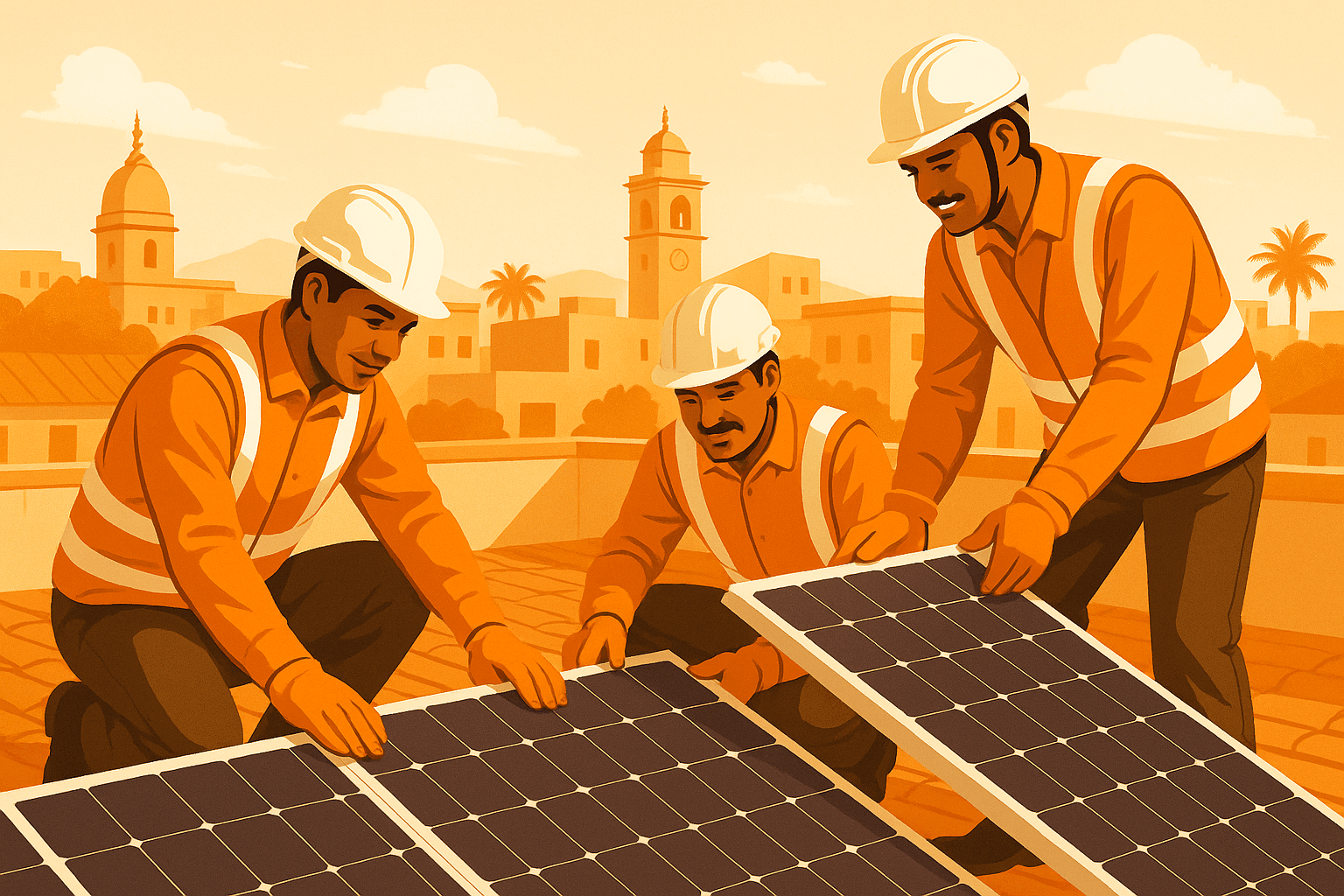
Best Solar Company in Dhule Maharashtra — How to Choose the Right Installer
Going solar is one of the best financial decisions you can make in 2026 — but choosing the wrong solar company can turn that smart decision into a nightmare. Poor installation quality, cheap components, fake warranties, vanishing installers — the solar industry in India has its share of bad actors, and Dhule is no exception.
The difference between a good and bad solar installation is not just about money. A properly installed system will run trouble-free for 25 years, generating lakhs of rupees in savings. A badly installed one can cause roof leaks, electrical fires, inverter failures within months, and — worst of all — void your eligibility for government subsidies.
This guide helps you navigate the solar installer landscape in Dhule and Maharashtra. We will cover exactly what certifications to look for, what questions to ask, which red flags should make you walk away, and why choosing a local installer with real expertise matters more than chasing the lowest quote.
Why Choosing the Right Solar Company Matters
Before we dive into the checklist, let us understand what is at stake:
| Factor | Good Installer | Bad Installer |
|---|---|---|
| System lifespan | 25–30 years | 5–10 years (failures start early) |
| Annual output | 1,500–1,600 kWh/kW | 1,000–1,200 kWh/kW (poor design) |
| 25-year savings | ₹8–10 lakh (3 kW) | ₹3–4 lakh (if system survives) |
| Subsidy eligibility | Full subsidy received | May be rejected or delayed |
| Warranty service | Local team responds in 24–48 hrs | Company unreachable after installation |
| Safety | Proper earthing, DC isolators, surge protection | Fire risk, electrical hazards |
A solar system is a 25-year asset on your roof. You would not trust a random contractor to build your house — do not trust a random installer with your solar system.
Essential Certifications — What to Check
1. MNRE Registration (Ministry of New and Renewable Energy)
This is the most important certification. Only MNRE-registered vendors can process PM Surya Ghar Muft Bijli Yojana subsidy applications. If your installer is not MNRE-registered, you will not receive the government subsidy — which can be up to ₹78,000.
How to verify: Ask for the MNRE vendor registration number. You can verify it on the pmsuryaghar.gov.in portal under the vendor list for Maharashtra.
2. BIS Certification for Panels (Bureau of Indian Standards)
All solar panels sold in India must carry BIS IS 14286 certification. This ensures the panels have been tested for safety, performance, and durability under Indian conditions. Panels without BIS certification are either counterfeit, smuggled, or sub-standard.
How to verify: Check for the ISI mark on the panel itself and ask for the BIS certificate number. Genuine panels will have a unique serial number traceable to the manufacturer.
3. MSEDCL Empanelment
For net metering in Maharashtra, the installer should ideally be empanelled with MSEDCL (Maharashtra State Electricity Distribution Company Limited). While this is not strictly mandatory (MNRE-registered vendors can also apply), MSEDCL-empanelled installers typically process net metering applications faster.
4. Electrical License
The person doing the actual electrical work — connecting the inverter to your distribution board, wiring the panels, installing the net meter — should hold a valid electrical contractor license issued by the Maharashtra government. This is a legal requirement, not optional.
5. GST Registration
A legitimate solar company will be GST-registered and provide a proper GST invoice. This matters because:
- You need the GST invoice for subsidy claims
- It proves the company is a legal entity (not a fly-by-night operation)
- You can verify the GST number on the government portal
Certification Checklist
| Certification | Why It Matters | How to Verify |
|---|---|---|
| MNRE Vendor Registration | Required for PM Surya Ghar subsidy | pmsuryaghar.gov.in vendor list |
| BIS IS 14286 (Panels) | Ensures panel quality and safety | ISI mark on panels + certificate |
| MSEDCL Empanelment | Faster net metering approval | MSEDCL website or office |
| Electrical Contractor License | Legal requirement for wiring | Ask for license copy |
| GST Registration | Legal entity + required for subsidy invoice | gst.gov.in verification |
| ISO 9001 (optional) | Quality management system | ISO certificate from accredited body |
10 Questions You Must Ask Before Signing
Do not be shy about asking tough questions. A good solar company will welcome them — they demonstrate that you are a serious, informed buyer. Here are the 10 questions every Dhule homeowner should ask:
1. "Can you show me 5 recent installations in Dhule/nearby areas?"
A reputable installer will have a portfolio of completed projects. Ask if you can visit one or two — seeing an actual installation and talking to the homeowner is the best reference check. If they cannot show you local work, that is a red flag.
2. "What brands of panels and inverter will you use? Are they BIS-certified?"
Get specific brand names, model numbers, and wattage. Do not accept vague answers like "Tier 1 panel" or "imported panel." Write the brands into the contract. Then independently verify the BIS certification.
3. "What is included in your warranty, and who honours it?"
There are typically three separate warranties:
- Panel performance warranty (25 years, from the manufacturer)
- Inverter warranty (5–10 years, from the inverter manufacturer)
- Workmanship/installation warranty (1–5 years, from the installer)
Ask specifically: "If my inverter fails in year 3, do I call you or the manufacturer?" The best installers act as a single point of contact for all warranty issues.
4. "Will you handle the MSEDCL net metering application?"
Net metering is essential for grid-connected systems — it is how you get credit for surplus power. The application process involves paperwork, technical drawings, and an MSEDCL inspection. A good installer handles this end-to-end at no extra charge.
5. "Will you handle the PM Surya Ghar subsidy application?"
Same as above — the subsidy application requires registration, document upload, pre-installation inspection, and post-installation verification. Your installer should manage the entire process and only charge you the post-subsidy amount (or refund you when the subsidy arrives).
6. "Can I see a detailed, itemized quotation?"
A transparent quote breaks down costs by component: panels, inverter, mounting structure, wiring, labour, net metering charges, and taxes. Be suspicious of round-number quotes like "₹1,50,000 all-inclusive" with no breakdown — it makes it easy to use cheaper components without you knowing.
7. "What is your annual maintenance plan?"
Solar systems need periodic maintenance — cleaning, inverter checks, cable inspection, earthing verification. Ask if the installer offers an Annual Maintenance Contract (AMC) and what it costs. Good installers include 1–2 years of free maintenance.
8. "How do you handle complaints and service calls?"
Ask about their response time for complaints. A local Dhule-based company can typically respond within 24 hours. An out-of-town installer might take a week — or simply stop answering calls.
9. "What is the expected generation from my system?"
A professional installer will give you a specific number based on your roof orientation, tilt angle, shading analysis, and Dhule's solar irradiance data. If they just say "you will save a lot," they have not done their homework.
10. "Do you use DC isolators, surge protection, and proper earthing?"
These are safety-critical components that some installers skip to cut costs:
- DC isolator — lets you safely disconnect the panels from the inverter (essential for firefighter safety)
- Surge protection device (SPD) — protects against lightning and power surges
- Earthing — prevents electric shock hazards
If an installer does not include these, walk away. The cost difference is ₹2,000–5,000, but skipping them puts your family's safety at risk.
Red Flags — When to Walk Away
1. Prices That Are "Too Good to Be True"
If an installer quotes significantly below market rates (say ₹30,000 for a 1 kW system that should cost ₹55,000), they are cutting corners somewhere — possibly using non-BIS panels, refurbished inverters, or thin aluminium mounting that will corrode in 2–3 years.
2. Pressure to Pay Full Amount Upfront
Standard payment terms in the solar industry are:
- 10–30% advance at contract signing
- 50–60% on material delivery (after you verify the brands)
- Remaining on commissioning (after the system is running and tested)
Any installer demanding 100% upfront is a scam risk.
3. No Physical Office or Address
A company that operates only through a mobile number and WhatsApp, with no verifiable office address, can disappear overnight. Visit their office before signing. In Dhule, this is easy to verify.
4. Reluctance to Show Certifications
If they stall, make excuses, or get defensive when you ask for MNRE registration, BIS certificates, or their electrical license — something is wrong. Legitimate companies are proud of their certifications.
5. Vague or Verbal Warranties
"We give 25 years warranty" means nothing without a written warranty card from the panel manufacturer. Get everything in writing — the warranty terms, what is covered, what is excluded, and the process for claiming warranty service.
6. No Site Visit Before Quoting
Any installer who gives you a final price over the phone or WhatsApp without visiting your site is being reckless. A proper quotation requires assessing:
- Roof area, type, and structural condition
- Shading from nearby buildings, trees, or water tanks
- Electrical panel capacity and condition
- Cable routing from roof to inverter to meter
- Compass orientation and tilt angle
7. Using Unknown or Chinese-Only Brands Without BIS
While many excellent solar panels are manufactured in China (Jinko, LONGi, Canadian Solar), they sell in India through authorized distributors with BIS certification. Beware of no-name panels with Chinese characters and no ISI mark — these are grey-market imports with no warranty protection in India.
8. No After-Sales Service Plan
Installation is just the beginning. Your system needs monitoring, maintenance, and occasional troubleshooting for the next 25 years. If the installer has no service team, no AMC options, and no plan for after-sales support, your 25-year investment is at risk.
Why Local Installers in Dhule Are Better
Here is a truth that applies to solar more than most industries: local matters.
Faster Response Time
When your inverter shows an error code at 2 PM on a hot May afternoon, you do not want to call a Mumbai-based company that will "send a technician next week." A Dhule-based team can be at your doorstep the same day.
Knowledge of Local Conditions
A local installer understands:
- Dhule's extreme summer heat (42–45°C) and how it affects panel output — they will recommend panels with better temperature coefficients
- Monsoon patterns — they know how to install mounting structures that withstand heavy rain and occasional hailstorms
- MSEDCL's local office procedures — they have relationships with the Dhule division office, which speeds up net metering approvals
- Roof types common in Dhule — flat RCC terraces, tin-sheet factory roofs, sloped village homes
Accountability
A company with an office in Dhule, staff who live in Dhule, and a reputation to protect in Dhule is far more accountable than a fly-in, fly-out installer from Pune or Mumbai. If they do a bad job, word spreads fast in a city like Dhule.
Service Area Coverage
AceSolarTech, for example, covers the entire North Maharashtra region:
- Dhule district — Dhule city, Shirpur, Sakri, Sindkheda, Shindkheda
- Jalgaon district — Jalgaon, Bhusawal, Pachora, Chopda, Erandol
- Nandurbar district — Nandurbar, Shahada, Taloda, Akkalkuwa
- Nashik district — Nashik, Malegaon, Manmad, Satana, Sinnar
- Plus — all of Maharashtra (Pune, Mumbai, Nagpur, Aurangabad, Kolhapur, and more)
Comparing Solar Companies in Dhule — What to Look For
Here is a framework for comparing quotes from multiple solar companies:
| Comparison Factor | Weight | What "Good" Looks Like |
|---|---|---|
| Price (after subsidy) | 25% | Competitive but not the cheapest — quality costs more |
| Panel brand & efficiency | 20% | BIS-certified, Tier 1, efficiency > 20% |
| Inverter brand | 15% | Reputable (Growatt, Goodwe, Fronius, SMA, Enphase) |
| Warranty terms | 15% | Written, detailed, manufacturer-backed |
| Installation quality | 10% | Photos of past work, proper earthing, cable management |
| After-sales service | 10% | AMC options, local team, response time guarantee |
| Subsidy handling | 5% | End-to-end, no extra charges |
Pro Tip: Get 3 Quotes
Always get quotes from at least 3 solar companies before deciding. Compare them on the framework above, not just price. The cheapest quote is rarely the best value — and the most expensive one is not automatically the best either.
Understanding Solar Warranties — What Is Actually Covered?
Warranties in solar can be confusing because there are multiple parties involved. Here is a clear breakdown:
Panel Performance Warranty (25–30 years)
| Year | Guaranteed Output |
|---|---|
| Year 1 | ≥ 97% of rated power |
| Year 2–12 | Degradation ≤ 0.5%/year |
| Year 12 | ≥ 92% of rated power |
| Year 25 | ≥ 84% of rated power |
| Year 30 (premium panels) | ≥ 80% of rated power |
Who honours it: The panel manufacturer (Adani, Tata, Waaree, etc.) — not your installer. This is why BIS-certified panels from established manufacturers matter.
Panel Product Warranty (10–12 years)
Covers manufacturing defects — cracked cells, junction box failure, delamination, hot spots. This is separate from performance warranty.
Inverter Warranty (5–10 years)
| Brand | Standard Warranty | Extended (Paid) |
|---|---|---|
| Growatt | 5 years | Up to 10 years |
| Goodwe | 5 years | Up to 10 years |
| Fronius | 5 years | Up to 10+5 years |
| SMA | 5 years | Up to 10 years |
| Enphase (micro) | 10 years | Up to 25 years |
Our recommendation: Always ask about extended inverter warranty. Paying ₹3,000–₹5,000 extra for an extended warranty saves you ₹15,000–₹25,000 if the inverter fails in year 6 or 7.
Workmanship Warranty (1–5 years)
This covers the installation quality — mounting structure integrity, wiring, connector crimping, waterproofing of roof penetrations. This warranty comes from your installer, not the manufacturer. This is why choosing a stable, local company matters — they need to be around to honour it.
The Installation Process — What to Expect
A professional solar installation in Dhule follows this timeline:
| Stage | Timeline | What Happens |
|---|---|---|
| 1. Site Visit | Day 1 | Engineer visits, assesses roof, takes measurements, checks shading |
| 2. System Design | Day 2–3 | Panel layout, inverter sizing, cable routing, structural analysis |
| 3. Quotation | Day 3–4 | Detailed, itemized quote with brand names and warranty terms |
| 4. Contract & Advance | Day 5 | Agreement signed, 20–30% advance payment |
| 5. Material Procurement | Day 6–12 | Panels, inverter, mounting hardware ordered/sourced |
| 6. Installation | Day 13–14 | Physical installation (usually 1–2 days for residential) |
| 7. Testing | Day 14 | System testing, generation verification, safety checks |
| 8. Net Metering Application | Day 15–20 | MSEDCL application, inspection, meter change |
| 9. Commissioning | Day 20–30 | System officially live, generation monitoring starts |
| 10. Subsidy Application | Day 30–45 | PM Surya Ghar portal upload, verification, subsidy credit |
Total timeline: 30–45 days from contract to fully commissioned and subsidy-applied system. AceSolarTech aims to complete installations within 3 weeks for standard residential projects in Dhule.
AceSolarTech — Your Trusted Solar Partner in Dhule
Here is what sets AceSolarTech apart:
Local Presence
Our office is at Shop No. 108, Shriram Shopping Complex, Sakri Road, Dhule — 424002. Our installation team lives in Dhule, and our service technicians cover the entire North Maharashtra region. We are not a distant call centre — we are your neighbours. Walk in anytime for a consultation.
Complete Service
From your first WhatsApp message to your 25th year of solar generation, we handle everything:
- Free site visit and custom system design
- Premium BIS-certified panels (Waaree, Adani, Tata)
- Professional installation by licensed electricians
- MSEDCL net metering application and follow-up
- PM Surya Ghar and SMART Solar subsidy processing
- 2 years of free annual maintenance
- Lifetime WhatsApp support
Transparent Pricing
Our quotes are detailed, itemized, and honest. No hidden costs, no surprise charges after installation. The price we quote is the price you pay — and we clearly show the subsidy deduction.
Proven Track Record
We have installed solar systems across Dhule district — homes, farms, commercial buildings, and government institutions. Ask us for references — we will connect you with happy customers who have been generating free electricity for years.
Ready to Go Solar in Dhule?
Choosing the right solar company is the most important decision in your solar journey. Do your research, ask the tough questions, and choose a partner who will be there for the long haul.
- Use our Solar Savings Calculator to estimate your savings
- Check our current deals for the best prices this month
- Read our complete pricing guide for detailed cost breakdowns
- WhatsApp AceSolarTech for a free, no-obligation consultation
Your roof, your savings, your future — choose wisely.
AceSolarTech — Dhule's Trusted Solar Installation Partner.