

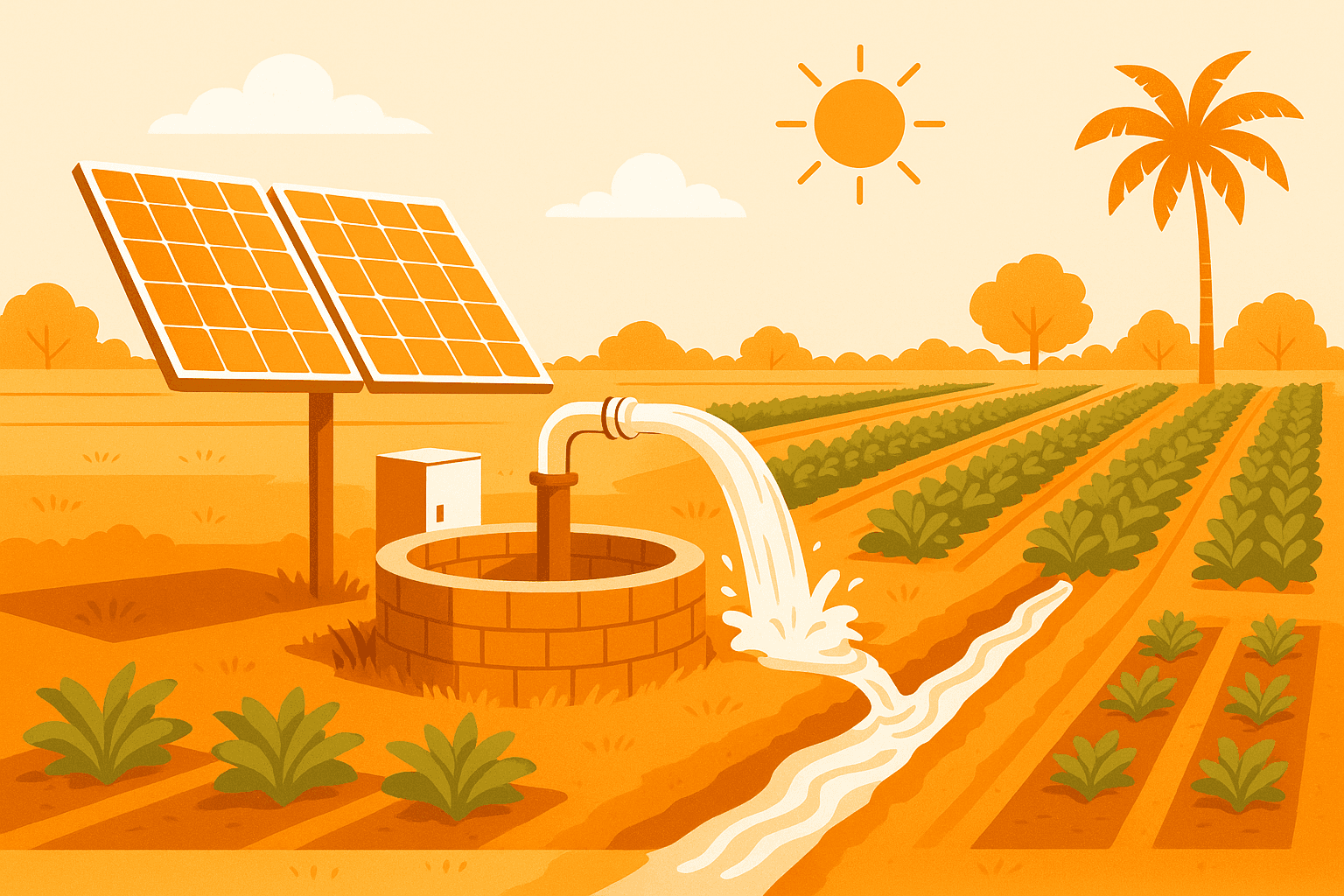
Solar Water Pump Price Maharashtra 2026 — KUSUM Subsidy Guide for Farmers
If you are a farmer in Maharashtra searching for solar water pump prices, you are making a decision that could save you ₹50,000 to ₹1,00,000 per year in diesel and electricity costs — and the government will pay for most of the pump. Under the PM-KUSUM Yojana and Maharashtra's own Mukhyamantri Saur Krushi Pump Yojana, farmers can get solar pumps with up to 90% government subsidy.
But with so many options — different HP ratings, AC vs DC pumps, submersible vs surface pumps — how do you know which solar pump is right for your farm? And how much will you actually pay after subsidy?
This guide gives you everything: complete pricing tables by HP, a detailed KUSUM subsidy breakdown, a diesel vs solar cost comparison that shows exactly how much you save, the right pump for your crops and well type, step-by-step application process in Maharashtra, and maintenance tips to keep your pump running for 25 years.
Solar Water Pump Prices in Maharashtra — 2026 Complete Price Table
Here are the current market prices for solar water pumps in Maharashtra, along with subsidy amounts and what you actually pay:
Submersible Solar Water Pumps (For Borewells/Tubewells)
| Pump Capacity | Total System Cost | KUSUM Subsidy (90%) | Farmer's Share (10%) | Daily Water Output* | Head (Depth) |
|---|---|---|---|---|---|
| 1 HP DC | ₹1,05,000 – ₹1,25,000 | ₹94,500 – ₹1,12,500 | ₹10,500 – ₹12,500 | 30,000–45,000 litres | Up to 30 metres |
| 2 HP DC | ₹1,55,000 – ₹1,80,000 | ₹1,39,500 – ₹1,62,000 | ₹15,500 – ₹18,000 | 50,000–75,000 litres | Up to 50 metres |
| 3 HP DC | ₹2,10,000 – ₹2,50,000 | ₹1,89,000 – ₹2,25,000 | ₹21,000 – ₹25,000 | 80,000–1,20,000 litres | Up to 70 metres |
| 5 HP AC | ₹3,20,000 – ₹3,80,000 | ₹2,88,000 – ₹3,42,000 | ₹32,000 – ₹38,000 | 1,20,000–1,80,000 litres | Up to 100 metres |
| 7.5 HP AC | ₹4,50,000 – ₹5,20,000 | ₹4,05,000 – ₹4,68,000 | ₹45,000 – ₹52,000 | 1,80,000–2,50,000 litres | Up to 150 metres |
| 10 HP AC | ₹5,80,000 – ₹6,80,000 | ₹5,22,000 – ₹6,12,000 | ₹58,000 – ₹68,000 | 2,50,000–3,50,000 litres | Up to 200 metres |
*Daily water output based on 6–7 hours of sunshine. Actual output depends on water table, pipe diameter, and total dynamic head.
Surface Solar Water Pumps (For Open Wells/Rivers/Canals)
| Pump Capacity | Total System Cost | KUSUM Subsidy (90%) | Farmer's Share (10%) | Daily Water Output | Suction Depth |
|---|---|---|---|---|---|
| 1 HP DC | ₹90,000 – ₹1,10,000 | ₹81,000 – ₹99,000 | ₹9,000 – ₹11,000 | 40,000–60,000 litres | Up to 8 metres |
| 2 HP DC | ₹1,30,000 – ₹1,55,000 | ₹1,17,000 – ₹1,39,500 | ₹13,000 – ₹15,500 | 70,000–1,00,000 litres | Up to 10 metres |
| 3 HP AC | ₹1,80,000 – ₹2,20,000 | ₹1,62,000 – ₹1,98,000 | ₹18,000 – ₹22,000 | 1,00,000–1,50,000 litres | Up to 12 metres |
| 5 HP AC | ₹2,80,000 – ₹3,40,000 | ₹2,52,000 – ₹3,06,000 | ₹28,000 – ₹34,000 | 1,50,000–2,00,000 litres | Up to 15 metres |
Key takeaway: With KUSUM subsidy, a farmer can get a 3 HP solar pump for just ₹21,000–₹25,000. This is less than the cost of diesel you would spend in 3–4 months.
What Is Included in the Solar Pump System?
When you buy a solar water pump system, the price includes:
| Component | Purpose | Lifespan |
|---|---|---|
| Solar Panels | Generate electricity from sunlight | 25 years |
| Pump Motor (DC or AC) | Drives the pump mechanism | 15–20 years |
| Pump Controller/VFD | Regulates power, protects motor from voltage fluctuations | 10–15 years |
| Mounting Structure | Ground-mounted frame for solar panels | 20+ years |
| Cables & Connectors | DC cables from panels to controller, AC cables to pump | 15–20 years |
| Pipe & Fittings | Water delivery pipes (HDPE/PVC) | 15–20 years |
| Installation | Professional installation and testing | One-time |
Not included: Water storage tank, drip/sprinkler irrigation setup, borewell drilling (if needed), and civil work for pump platform.
DC vs AC Solar Pumps — Which One Should You Choose?
| Feature | DC Solar Pump | AC Solar Pump |
|---|---|---|
| Motor type | Brushless DC motor | Standard 3-phase AC induction motor |
| Efficiency | Higher (85–92%) | Moderate (70–80%) |
| Available sizes | 1 HP – 5 HP | 3 HP – 25 HP |
| Controller | Simple MPPT controller | Variable Frequency Drive (VFD) |
| Works in low sunlight? | Yes (starts at 30% sunlight) | Needs stronger sunlight (50%+) |
| Maintenance | Very low (no brushes) | Moderate (bearings, impellers) |
| Price | 10–15% higher | Standard pricing |
| Best for | Small farms, borewells up to 100m | Large farms, deep borewells, heavy irrigation |
Our Recommendation
- Small farms (1–3 acres) with shallow wells (up to 70m): Go with a DC pump (1–3 HP). They are more efficient, work in cloudy conditions, and need minimal maintenance.
- Medium farms (3–10 acres) with deeper borewells (70–200m): An AC pump (5–7.5 HP) is the practical choice. AC motors are cheaper to replace and locally available.
- Large farms (10+ acres) or heavy irrigation needs: A 10 HP AC pump provides the volume needed for crops like sugarcane, banana, and paddy.
Diesel vs Solar Pump — Cost Comparison Over 10 Years
Let us put the numbers side by side. We will compare a 5 HP diesel pump with a 5 HP solar pump over 10 years:
| Cost Factor | Diesel Pump (5 HP) | Solar Pump (5 HP) |
|---|---|---|
| Pump purchase cost | ₹25,000 – ₹35,000 | ₹3,20,000 – ₹3,80,000 |
| Government subsidy | None | ₹2,88,000 – ₹3,42,000 (90%) |
| Your actual cost | ₹25,000 – ₹35,000 | ₹32,000 – ₹38,000 |
| Daily fuel cost (6 hrs) | ₹500 – ₹700 | ₹0 (free sunshine) |
| Annual fuel/electricity cost | ₹60,000 – ₹84,000 | ₹0 |
| Annual maintenance | ₹8,000 – ₹12,000 | ₹2,000 – ₹3,000 |
| Total cost over 10 years | ₹7,05,000 – ₹9,95,000 | ₹52,000 – ₹68,000 |
| Savings with solar | — | ₹6,50,000 – ₹9,30,000 |
A solar pump saves you ₹6.5 to ₹9.3 lakh over 10 years compared to diesel. And the solar pump keeps working for another 15 years after that — completely free.
Beyond Money: Other Advantages of Solar Pumps
- No diesel hassle — no trips to the petrol pump, no fuel storage, no fuel theft
- No noise pollution — diesel pumps are deafeningly loud; solar pumps are silent
- No air pollution — zero emissions, good for your health and the environment
- Reliable daytime operation — works precisely when crops need water most (daytime)
- No load-shedding — independent of MSEDCL grid and its unpredictable power cuts
- Low maintenance — no oil changes, no fuel filters, no engine overhauls
KUSUM Subsidy for Solar Pumps — How It Works
PM-KUSUM Yojana — Component B (Standalone Solar Pumps)
| Subsidy Component | Percentage | Who Pays |
|---|---|---|
| Central Government | 30% | Ministry of New & Renewable Energy (MNRE) |
| State Government (Maharashtra) | 30% | MEDA (Maharashtra Energy Development Agency) |
| Farmer's contribution | 30% | Your share (can be bank loan) |
| Bank loan (optional) | 10% | Can replace part of farmer's share |
| Total | 100% |
Effective farmer payment: 30–40% of system cost. However, with Maharashtra's additional state schemes, the total subsidy can reach up to 90%, bringing your share down to just 10%.
Maharashtra State Schemes — Additional Subsidy
| Scheme | Additional State Subsidy | Total Subsidy | Farmer Pays |
|---|---|---|---|
| Mukhyamantri Saur Krushi Pump Yojana (MSKPY) | Up to 60% (state) | 90% | 10% |
| Magel Tyala Saur Krushi Pump Yojana | Up to 60% (state) | 90–95% | 5–10% |
| KUSUM Component B (Standard) | 30% (state) | 60% | 40% (can use bank loan) |
Who Is Eligible?
| Eligibility Criterion | Requirement |
|---|---|
| Landholding | Must own agricultural land in Maharashtra |
| Existing pump | Should not have an existing electric pump on the same land (for MSKPY) |
| Water source | Must have a functional well, borewell, or water source |
| 7/12 Extract | Required (land ownership proof from Talathi office) |
| Aadhaar linked | Bank account must be Aadhaar-linked for subsidy transfer |
Which Solar Pump for Which Crop and Well?
Choosing the right pump size depends on your farm size, water source, and crops. Here is a practical guide:
By Farm Size and Crop
| Farm Size | Primary Crop | Water Need | Recommended Pump | Panel Array |
|---|---|---|---|---|
| 1–2 acres | Vegetables, flowers, herbs | 30,000–50,000 litres/day | 1–2 HP DC submersible | 4–6 panels (1.2–1.8 kW) |
| 2–3 acres | Wheat, jowar, bajra, pulses | 50,000–80,000 litres/day | 2–3 HP DC submersible | 6–10 panels (1.8–3 kW) |
| 3–5 acres | Cotton, soybean, groundnut | 80,000–1,20,000 litres/day | 3–5 HP AC submersible | 10–16 panels (3–5 kW) |
| 5–10 acres | Sugarcane, banana, grapes | 1,50,000–2,50,000 litres/day | 5–7.5 HP AC submersible | 16–24 panels (5–7.5 kW) |
| 10–20 acres | Sugarcane, paddy, orchards | 2,50,000–4,00,000 litres/day | 7.5–10 HP AC submersible | 24–32 panels (7.5–10 kW) |
By Well Type and Depth
| Water Source | Depth | Recommended Pump Type | Recommended HP |
|---|---|---|---|
| Open well (विहीर) | 5–15 metres | Surface pump | 1–3 HP |
| Shallow borewell | 15–50 metres | DC submersible | 1–3 HP |
| Medium borewell | 50–100 metres | DC or AC submersible | 3–5 HP |
| Deep borewell | 100–200 metres | AC submersible | 5–10 HP |
| River/canal | Surface | Surface pump | 3–5 HP |
| Farm pond (शेततळे) | 3–10 metres | Surface pump | 1–2 HP |
Regional Recommendations for Maharashtra
| Region | Common Crops | Typical Well Depth | Recommended Pump |
|---|---|---|---|
| Khandesh (Dhule, Jalgaon, Nandurbar) | Cotton, banana, jowar | 30–80 metres | 3–5 HP submersible |
| Nashik division | Grapes, onion, tomato | 40–100 metres | 3–5 HP submersible |
| Western Maharashtra (Pune, Satara, Kolhapur) | Sugarcane, turmeric | 20–60 metres | 3–5 HP AC |
| Marathwada (Aurangabad, Beed, Latur) | Soybean, cotton, tur | 50–150 metres | 5–7.5 HP AC |
| Vidarbha (Nagpur, Amravati, Akola) | Cotton, orange, soybean | 40–120 metres | 5–7.5 HP AC |
| Konkan (Ratnagiri, Sindhudurg) | Cashew, mango, rice | 10–40 metres | 1–3 HP DC |
How to Apply for KUSUM Solar Pump in Maharashtra — Step by Step
Step 1: Check Eligibility and Gather Documents
Required documents:
- 7/12 Extract (सात-बारा उतारा) — must be recent (within 6 months)
- 8A Extract (आठ-अ उतारा) — land mutation record
- Aadhaar card
- Bank passbook (Aadhaar-linked account)
- Passport-size photos (2)
- Caste certificate (if applying under SC/ST quota)
- Existing pump details (if any — to show you do not have an electric pump for MSKPY)
Step 2: Register Online
For PM-KUSUM Component B:
- Visit the PM-KUSUM portal
- Select Maharashtra as your state
- Fill in the application form with land and personal details
- Upload all documents
For Mukhyamantri Saur Krushi Pump Yojana (MSKPY):
- Visit mahadiscom.in/solar or the MEDA portal
- Register using your MSEDCL consumer number or new application
- Fill the application form
- Upload documents
Step 3: Application Verification
- Your application is verified by the district agriculture office
- A field inspection may be conducted to verify your water source and land ownership
- Timeline: 15–30 days
Step 4: Approval and Vendor Selection
- Once approved, you receive an approval letter
- You can choose an empanelled vendor (like AceSolarTech)
- The vendor conducts a site visit and recommends the appropriate pump
Step 5: Payment of Farmer's Share
- You pay your share (10–40% depending on scheme) to the vendor
- This can be via bank loan (SBI, Bank of Maharashtra offer special solar pump loans at 7–8% interest)
- The subsidy portion is paid directly to the vendor by the government
Step 6: Installation
- The vendor installs the solar pump system (typically 2–3 days)
- System testing and commissioning
- Training for the farmer on basic operation and maintenance
Step 7: Inspection and Subsidy Release
- MEDA or MSEDCL inspector visits to verify the installation
- Photos and documentation uploaded to the portal
- Subsidy released to the vendor (your share is already paid)
Total timeline: 2–4 months from application to working solar pump.
Pro tip: The demand for KUSUM pumps is very high in Maharashtra. New batches get booked within hours. AceSolarTech monitors the portal and can help you apply the moment a new batch opens. Contact us on WhatsApp to get on our priority notification list.
Top Solar Pump Brands Available in Maharashtra
| Brand | Pump Type | HP Range | Warranty | Price Range | Strengths |
|---|---|---|---|---|---|
| Tata Power Solar | DC & AC | 1–10 HP | 5 years pump, 25 years panels | ₹₹₹ | Reliability, brand trust |
| Waaree Solar | DC & AC | 1–10 HP | 5 years pump, 25 years panels | ₹₹ | Best value, wide availability |
| Shakti Solar (Jain Irrigation) | DC & AC | 1–10 HP | 5 years pump, 25 years panels | ₹₹ | Farmer-focused, drip combo |
| Lubi Solar | DC & AC | 1–7.5 HP | 5 years pump, 25 years panels | ₹₹ | Pump specialist, durable |
| CRI Solar | DC & AC | 1–10 HP | 5 years pump, 25 years panels | ₹₹ | Excellent submersible pumps |
| Kirloskar Solar | AC | 3–10 HP | 5 years pump, 25 years panels | ₹₹₹ | Legendary pump quality |
| Grundfos Solar | DC & AC | 1–7.5 HP | 5 years pump, 25 years panels | ₹₹₹₹ | Premium, highest efficiency |
Our Recommendation for Maharashtra Farmers
For most farms in Dhule, Jalgaon, Nandurbar, and North Maharashtra, we recommend Waaree Solar or Shakti Solar (Jain Irrigation) pump systems. Both offer excellent reliability at competitive prices, are widely supported in Maharashtra, and have strong after-sales service networks in the region.
For premium installations where maximum water output matters (large sugarcane or banana farms), Grundfos or Kirloskar pumps deliver superior performance.
Solar Pump Maintenance — Keep It Running for 25 Years
Solar pumps require minimal maintenance compared to diesel pumps — but "minimal" does not mean "zero." Here is your maintenance checklist:
Monthly Maintenance
| Task | How | Time |
|---|---|---|
| Clean solar panels | Soft cloth or gentle water spray — remove dust, bird droppings, leaves | 15 minutes |
| Check pump output | Observe water flow — any reduction could indicate a clogged filter or dropping water table | 5 minutes |
| Inspect cables | Look for rodent damage, loose connections, exposed wiring | 10 minutes |
Quarterly Maintenance
| Task | How | Time |
|---|---|---|
| Clean foot valve/strainer | Remove and clean the foot valve to prevent clogging | 30 minutes |
| Check mounting structure | Ensure bolts are tight, no rust or corrosion | 15 minutes |
| Verify controller LEDs | Check for any error indicators on the pump controller/VFD | 5 minutes |
Annual Maintenance
| Task | How | Time |
|---|---|---|
| Professional inspection | Certified technician checks all electrical connections, earthing, and pump performance | 2 hours |
| Panel performance check | Measure actual output vs expected output — degradation > 1%/year may indicate a problem | 1 hour |
| Water table check | Measure water level in your borewell — if it has dropped, you may need to adjust pump settings | 30 minutes |
Common Problems and Solutions
| Problem | Likely Cause | Solution |
|---|---|---|
| Pump not starting | Low sunlight, loose cable, controller fault | Check connections, wait for stronger sun, call technician if controller LED shows error |
| Low water output | Clogged filter, dropping water table, panel dust | Clean foot valve and panels, check water level |
| Pump runs but no water | Air lock, pipe leak, dried well | Check pipe joints, prime the pump, check water source |
| Controller error | Voltage fluctuation, overheating | Shade the controller, check for panel damage |
| Panels not generating | Dust, shade, cable damage | Clean panels, trim nearby trees, inspect cables |
AceSolarTech maintenance: We offer an Annual Maintenance Contract (AMC) for ₹2,000–₹5,000/year covering two visits, panel cleaning, pump inspection, and priority support for any breakdowns.
Drip Irrigation + Solar Pump = Maximum Efficiency
The smartest combination for Maharashtra farmers is solar pump + drip irrigation. Here is why:
| Irrigation Method | Water Efficiency | Suitable Crops | Combined Cost with 3 HP Solar Pump |
|---|---|---|---|
| Flood irrigation | 30–40% | Rice, sugarcane (traditional) | ₹21,000 (pump only) |
| Sprinkler | 60–70% | Wheat, jowar, groundnut | ₹45,000–₹65,000 (pump + sprinkler) |
| Drip irrigation | 85–95% | All vegetables, fruits, cotton, sugarcane | ₹60,000–₹1,00,000 (pump + drip) |
Government drip subsidy: The Maharashtra government provides 55–80% subsidy on drip irrigation under the Pradhan Mantri Krishi Sinchai Yojana (PMKSY). Combined with the KUSUM solar pump subsidy, a farmer can set up a complete solar-powered drip irrigation system for a fraction of the actual cost.
For example:
- 3 HP solar pump: ₹2,30,000 (cost) → ₹23,000 (after KUSUM 90% subsidy)
- Drip irrigation for 3 acres: ₹1,20,000 (cost) → ₹24,000 (after PMKSY 80% subsidy for SC/ST)
- Total farmer investment: ₹47,000 for a system worth ₹3,50,000
This combination typically increases crop yield by 20–40% while reducing water usage by 50–60% compared to flood irrigation with a diesel pump.
Financing Options for Solar Pumps
Even the farmer's 10–40% share can be financed:
| Bank/Institution | Loan Type | Interest Rate | Tenure | EMI for ₹35,000 |
|---|---|---|---|---|
| SBI Kisan Credit Card | Agriculture loan | 7.0% | 5 years | ₹693/month |
| Bank of Maharashtra | Farm equipment loan | 7.5% | 5 years | ₹701/month |
| NABARD refinance | Through cooperative banks | 6.5–7.5% | 5–7 years | ₹495–₹693/month |
| District Central Cooperative Bank | Agriculture loan | 7.0–8.0% | 3–5 years | ₹693–₹1,066/month |
Many state-run schemes offer interest subvention (additional interest subsidy) of 3%, bringing the effective interest rate down to just 4–4.5% for small and marginal farmers.
Frequently Asked Questions
How many hours does a solar pump run per day?
A solar pump runs during daylight hours — typically 6–8 hours per day in Maharashtra (starting from around 9 AM to 4–5 PM). During peak summer months (March–May), you can get up to 8–9 hours. During monsoon (June–September), expect 4–5 hours on cloudy days.
Can I use a solar pump at night?
Standard standalone solar pumps do not work at night. However, you can add a battery bank to store energy for nighttime use — this adds ₹50,000–₹1,50,000 to the cost depending on the capacity. Most farmers do not need nighttime pumping since crops absorb water best during daytime.
What happens during monsoon?
Solar pumps generate less power during cloudy monsoon days. However, during monsoon, most crops receive rain and irrigation demand is lowest. The pump works hardest during the dry season (October–May) when sun hours and water demand are both high — a perfect match.
Can I power other things with the solar panels?
Under KUSUM Component B, the solar panels are meant exclusively for the pump. However, under Component C (solarisation of grid-connected pumps), you can sell surplus power to MSEDCL and earn money.
How long does a solar pump last?
Solar panels last 25+ years. The pump motor typically lasts 15–20 years with proper maintenance. The controller/VFD lasts 10–15 years. So you may need one controller replacement and possibly one motor replacement over the 25-year panel life.
Get Your Solar Pump Today — AceSolarTech Can Help
AceSolarTech is an MNRE-empanelled solar pump installer serving all of Maharashtra. Here is how we help farmers:
- Free farm assessment — our team visits your farm, checks your well/borewell, and recommends the right pump
- Application assistance — we help you apply for KUSUM/MSKPY subsidy, including document preparation and portal registration
- End-to-end installation — from solar panels to pump to piping, we handle everything
- Drip irrigation combo — we can install drip/sprinkler systems along with the solar pump
- After-sales support — annual maintenance, spare parts, and warranty service
Next Steps
- Use our Solar Savings Calculator — works for agricultural pumps too
- See current pump deals — we have special pricing for Khandesh-region farmers
- Read our KUSUM Yojana guide — detailed scheme information
- WhatsApp us — get a free farm assessment
Every day you run a diesel pump, you are burning money. Switch to solar and let the sun power your farm for free — for the next 25 years.
AceSolarTech — Powering Maharashtra's Farms with Solar Energy.